
A customer calls about a failed payment, another wants a loan status update, and hundreds more are waiting for card, account, and onboarding support. At the same time, compliance teams need accurate documentation, operations teams are stuck in manual reviews, and leaders are under pressure to reduce costs.
This pressure is why AI is becoming a major investment priority. Even research shows that spending across banking, insurance, capital markets, and payments is expected to reach $97 billion by 2027. This shows that AI in banking is no longer only about automation. It is becoming a way for banks to improve service speed and support decision-making.
This blog covers how AI in banking works, the most valuable use cases, key benefits, common risks, and how AI agents are changing banking operations.
Executive Summary: AI in banking transforms enterprise operations by automating high-volume tasks, improving decision-making, and enhancing customer experiences. From customer support and onboarding to fraud detection and back-office automation, AI reduces manual work, speeds processes, and ensures compliance. Modern AI agents deliver consistent, 24/7 service across voice, chat, and internal workflows, helping banks scale efficiently while maintaining security and trust.
TL;DR
- Query Overload: AI in banking helps enterprise teams handle high volumes of customer queries across voice, chat, and back-office workflows efficiently.
- Operational Efficiency: Automates repetitive tasks like document review, reconciliation, and support tickets, reducing manual effort and speeding workflows.
- Enhanced Decision-Making: Analyzes large datasets quickly for fraud detection, risk assessment, and process prioritization while keeping humans in the loop.
- Customer Experience: Provides 24/7 support via AI voice and chat agents, delivering faster, consistent, and brand-aligned service.
- Risk Mitigation: Improves compliance readiness, detects unusual activity, and supports audit trails to maintain security and trust.
What Is AI in Banking?
AI in banking is the use of artificial intelligence to automate banking tasks, analyze financial data, support customer interactions, and improve decision-making across banking operations. It helps banks handle tasks such as customer support, fraud detection, loan processing, document review, compliance checks, and personalized service more quickly and consistently.
For enterprise leaders or Directors and VPs of Support, AI in banking is a way to manage high query volumes, reduce manual effort, improve response times, and support customers across voice, chat, and back-office workflows without adding more pressure on human teams.
To understand its impact today, it helps to look at how AI in banking has evolved over time.
Also Read: Use Cases and Role of Large Language Models in Finance and Banking Industry
The Evolution of AI in Banking
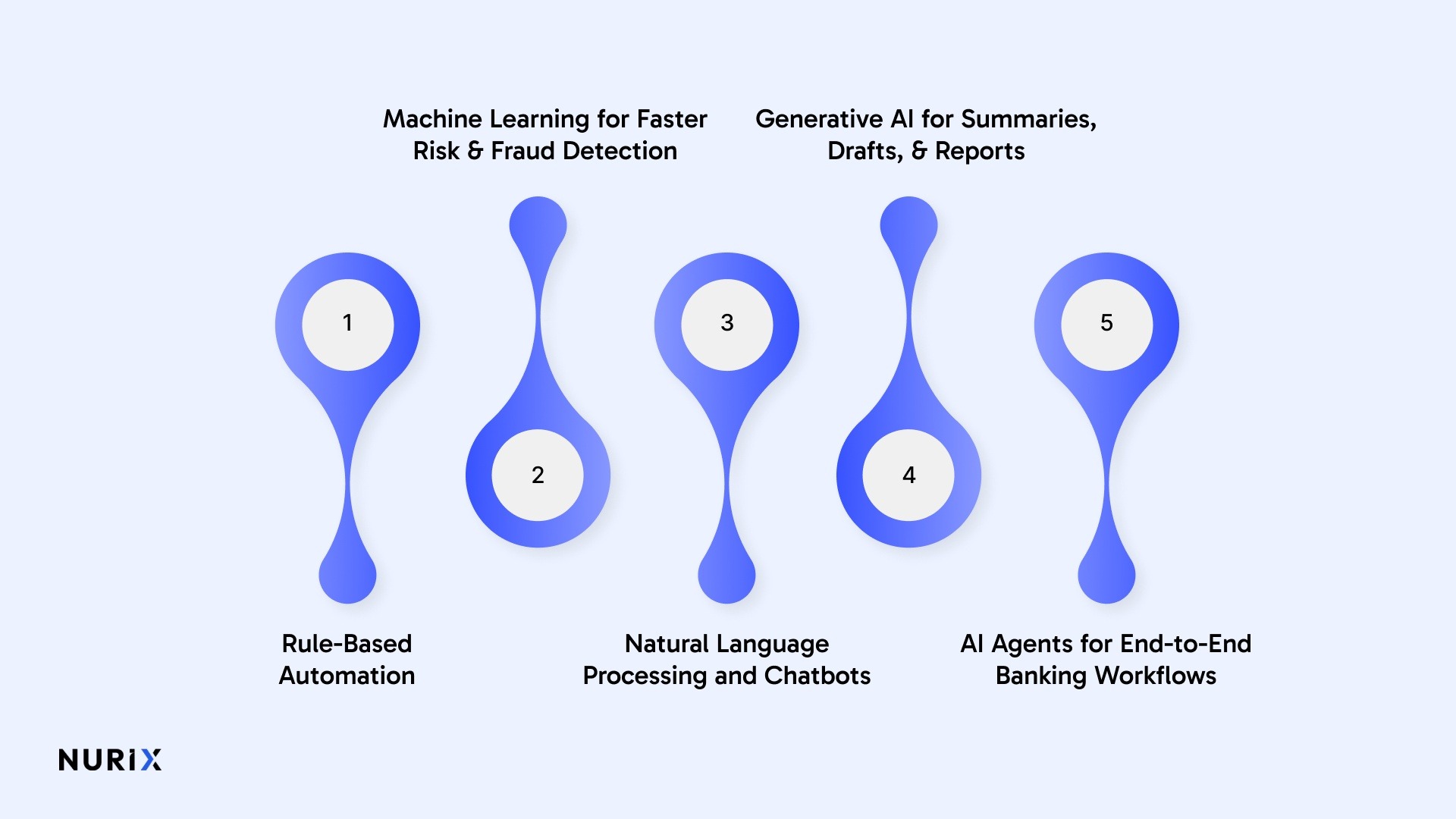
AI in banking has moved from simple rule-based systems to intelligent agents that can support customer service, risk checks, document work, and multi-step operations.
Here are the key stages in the evolution of AI in banking:
1. Rule-Based Automation
Early AI worked like digital rulebooks, following fixed instructions to give predictable “yes/no” outputs. This helped automate simple decisions but couldn’t understand context, adapt to new information, or handle complex customer situations.
2. Machine Learning for Faster Risk and Fraud Detection
Banks began using machine learning to analyze large volumes of data, detect fraud, flag unusual transactions, assess risk, and respond faster. This shifted teams from slow manual review to faster, data-driven monitoring.
3. Natural Language Processing and Chatbots
The next stage brought Natural Language Processing, or NLP, into banking. NLP-enabled systems to understand human language. Chatbots and virtual assistants could answer common questions and guide customers through basic tasks, reducing pressure on support teams. Early bots were limited in handling complex workflows.
4. Generative AI for Summaries, Drafts, and Reports
Generative AI added a new layer by creating useful work outputs, not just predictions. Generative AI produces work outputs, not just predictions. It can summarize conversations, draft responses, explain policies, and generate structured reports. This reduces manual effort across support, sales, compliance, and back-office workflows.
5. AI Agents for End-to-End Banking Workflows
The latest stage is AI agents. Modern AI agents go beyond answering questions; they understand intent, retrieve approved information, update systems, route cases, trigger workflows, and escalate when needed.
These agents help manage high-volume queries, improve response times, reduce repetitive work, and deliver more consistent customer experiences across voice, chat, and back-office systems.
As AI in banking has matured from rule-based automation to intelligent agents, its impact has expanded from simple task completion to measurable business value.
Benefits of AI in Banking
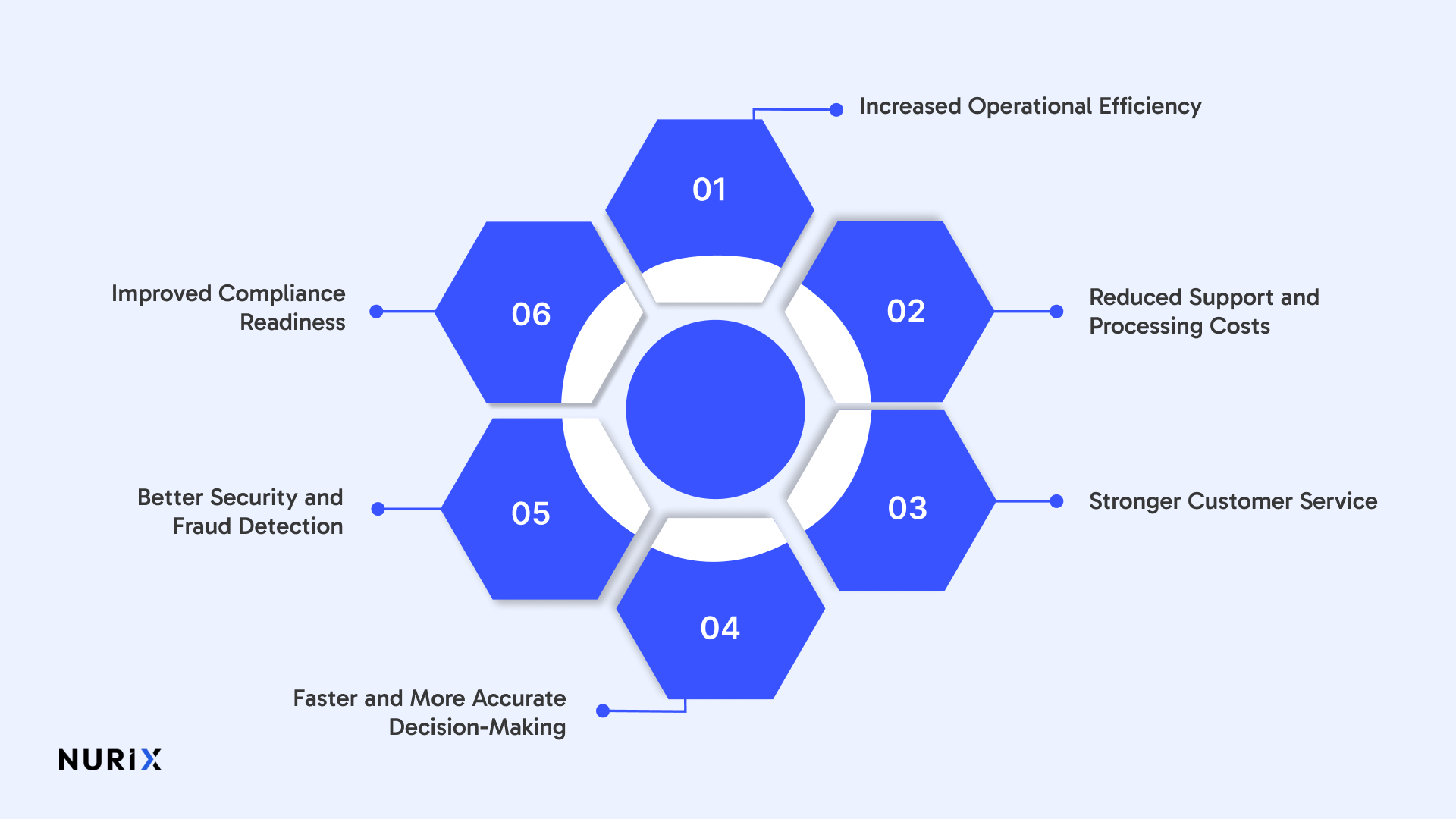
AI in banking helps you reduce manual work, respond to customers faster, and run banking operations with more consistency. For high-volume enterprise teams, the biggest benefit is better speed, control, and scalability across support, sales, operations, and compliance workflows.
Here are the key benefits of AI in banking:
1. Increased Operational Efficiency
AI automates repetitive workflows like document review, customer inquiries, reconciliation, and compliance checks. It extracts information, classifies requests, and routes cases, allowing teams to handle higher volumes without adding headcount.
2. Reduced Support and Processing Costs
AI agents manage routine interactions across voice, chat, and digital channels, easing pressure on support and operations teams. This lowers cost per interaction and frees human agents for escalations and revenue-impacting work.
3. Stronger Customer Service
AI-powered voice and chat agents provide 24/7 support for payment issues, card queries, account questions, loan updates, and onboarding. Customers receive faster, more consistent service even outside business hours or during peak demand.
4. Faster and More Accurate Decision-Making
AI can analyze large volumes of transaction, customer, and risk data faster than manual review. This helps teams identify patterns, prioritize cases, and make better-informed decisions. For operations teams, this is useful when you need quick visibility across customer behavior, risk signals, support trends, and process bottlenecks.
5. Better Security and Fraud Detection
AI detects unusual transactions, flags suspicious activity, and supports fraud investigation workflows. It helps leaders maintain revenue and trust while providing audit trails and escalation paths for high-risk cases.
6. Improved Compliance Readiness
AI can help with documentation, monitoring, reporting, audit trails, and policy-based routing. This makes it easier for your teams to track what happened, why a decision was made, and when a case was escalated. For compliance, operations, and technology leaders, this improves control over AI-driven workflows.
These benefits matter most when AI is applied to high-pressure banking use cases.
Common Use Cases of AI in Banking
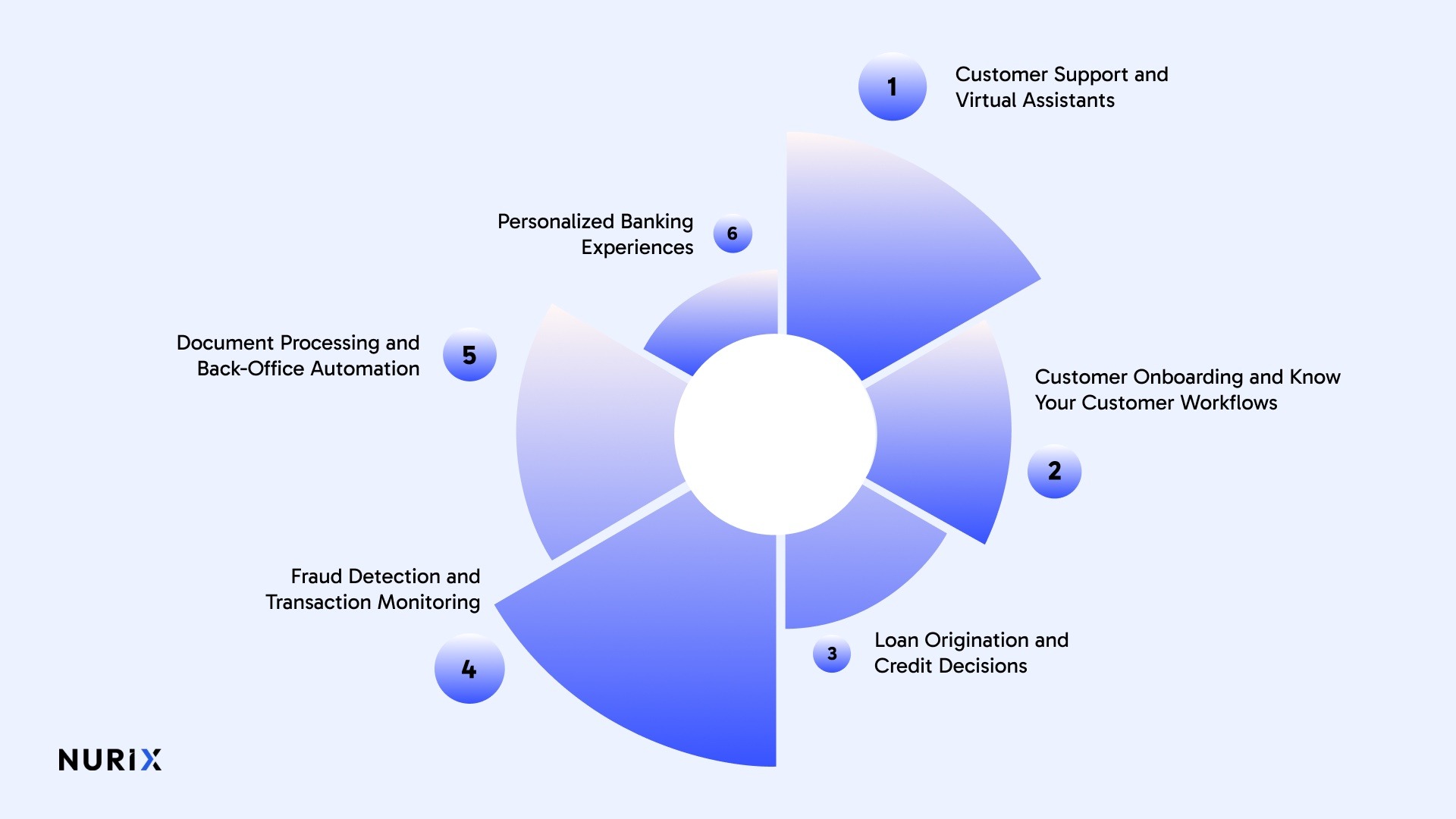
AI in banking is used to automate high-volume customer interactions, speed up document-heavy workflows, improve risk detection, and support better decisions. For enterprise teams, the most valuable use cases are the ones that reduce repetitive work while keeping humans in control of sensitive decisions.
Here are the most common use cases of AI in banking:
1. Customer Support and Virtual Assistants
Banking support teams often handle the same questions every day: account balances, card issues, failed payments, transaction disputes, loan updates, and appointment requests. AI-powered voice and chat assistants help you respond to these routine queries faster, without making customers wait in long queues.
How AI helps
- Answers account-related queries through voice or chat.
- Helps with card blocking, replacement, and status updates.
- Responds to transaction and payment-related questions.
- Shares the loan application or repayment status.
- Books branch appointments or service callbacks.
- Escalates complex cases to human agents with full context.
With NuPlay by Nurix AI, you can build enterprise-grade voice and chat agents optimized for real-world conversations. We enhance this process by delivering AI agents that align with your brand voice using NuRep. Our agents can communicate in a consistent, professional tone across voice and chat, learn from your knowledge base, playbooks, and past interactions.
This ensures customers experience reliable, brand-consistent support, while your teams gain efficiency and reduce repetitive workloads.
2. Customer Onboarding and Know Your Customer Workflows
Customer onboarding is one of the most important banking workflows, but it often involves multiple manual steps. Banks need to verify identity, collect documents, assess risk, and help customers complete account setup.
Know Your Customer (KYC) is the process banks use to verify a customer’s identity and assess potential risk before offering financial services.
How AI helps
- Verifies identity documents against required fields.
- Collects missing documents from customers.
- Checks whether submitted forms are complete.
- Supports initial risk scoring based on approved rules.
- Sends follow-ups when information is missing.
- Guides customers through account setup steps.
3. Loan Origination and Credit Decisions
Loan origination involves collecting applications, reviewing income documents, checking credit data, identifying inconsistencies, and preparing cases for decision-makers. This process can become slow when teams rely heavily on manual review.
How AI helps
- Captures loan application details from digital or voice channels.
- Reviews income documents and supporting files.
- Flags missing or inconsistent information.
- Supports preliminary credit risk assessment.
- Routes applications to the right review team.
- Prepares summaries for human decision-makers.
4. Fraud Detection and Transaction Monitoring
Banks process large volumes of transactions every day. Manual review alone cannot quickly detect every unusual pattern, especially as fraud tactics become more complex. Fraud can damage customer trust, increase losses, and create regulatory exposure.
How AI helps
- Monitors transactions in real time.
- Detects unusual spending or transfer patterns.
- Flags suspicious account activity.
- Prioritizes high-risk cases for review.
- Reduces false positives over time through better pattern recognition.
- Supports Anti-Money Laundering (AML) workflows by identifying suspicious activity.
5. Document Processing and Back-Office Automation
Banking operations depend on documents: loan forms, compliance files, contracts, statements, reports, and reconciliation records. When these documents are handled manually, teams spend hours extracting, checking, and routing information.
How AI helps
- Extracts data from loan documents and compliance forms.
- Classifies documents by type and priority.
- Flag missing or incorrect information.
- Summarizes contracts, statements, and internal reports.
- Routes documents to the right team or workflow.
- Supports reconciliation by comparing records across systems.
With NuPlay by Nurix AI, you can deploy AI Work Assistants that handle complex internal workflows, including document intelligence and back-office automation. Our AI agents read, process, and reconcile documents, flag deviations, escalate only exceptions, and generate audit-ready outputs.
6. Personalized Banking Experiences
Customers expect banks to understand their needs, but personalization must be practical and responsible. AI can help banks use customer data to deliver more relevant support, alerts, and guidance without overwhelming customers.
How AI helps
- Recommends relevant products based on customer behavior.
- Sends proactive alerts for payment issues or account activity.
- Explains financial products in simple language.
- Guides customers through personalized support journeys.
- Identifies customer retention signals.
- Helps agents understand customer context before a conversation.
AI should not push random offers or make sensitive recommendations without controls. The best use of AI is to make banking interactions more relevant, timely, and useful.
While these use cases show strong potential, they also pose challenges related to security, compliance, accuracy, bias, and human oversight.
Challenges of AI in Banking
AI in banking can improve efficiency, but it also brings risks that banks must manage carefully. For heads, the main challenge is using AI without weakening security, compliance, accuracy, or customer trust.
Here are the key challenges of AI in banking:
- Data Security and Privacy: Banks handle sensitive financial data, including Personally Identifiable Information (PII) such as names, account details, addresses, and transaction history. Use encryption, role-based access, PII redaction, and clear data retention controls to protect customer information.
- Compliance and Regulatory Complexity: Banks operate in highly regulated environments where AI systems must be audit-ready and aligned with internal policies and regulatory expectations. Maintain audit logs, human review steps, policy-based routing, and compliance checks across AI-assisted workflows.
- Bias and Fairness: AI can produce biased outputs if it learns from incomplete, outdated, or unbalanced data. Regularly test AI outputs, review training data, monitor performance, and keep humans involved in sensitive decisions.
- Explainability: Banks need to understand and document how AI-assisted decisions are made. Use transparent workflows, track data sources, and document AI recommendations so teams can audit and review them.
- Legacy System Integration: Many banks still rely on older core systems, customer databases, and back-office tools. Use secure integrations, Application Programming Interfaces (APIs), and phased rollouts to connect AI with existing systems.
- Change Management: AI adoption changes how support, operations, sales, and compliance teams work. Train teams, define ownership, set escalation rules, and introduce AI gradually into high-volume workflows.
While these challenges are significant, enterprise banks can overcome them with advanced AI solutions designed for scale, security, and compliance.
Also Read: How Conversational AI is Transforming Banking Services
How NuPlay by Nurix AI Helps Banks Deploy Enterprise-Grade AI Agents
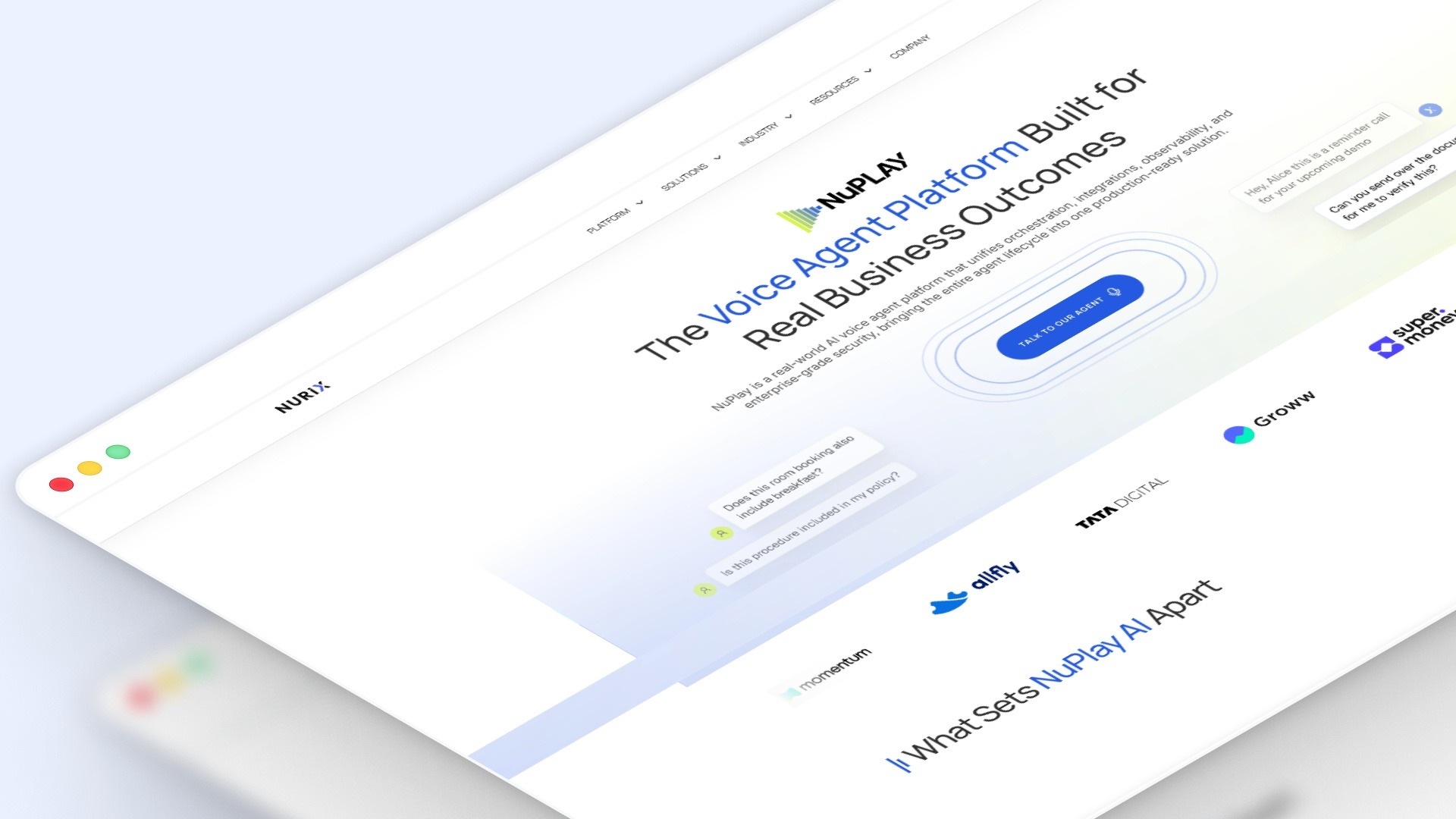
Banks do not just need AI that can answer basic customer questions. They need AI agents that can handle high-volume conversations, understand customer intent, connect with internal systems, and complete real banking workflows without weakening trust, security, or compliance.
When support, sales, and operations teams rely on disconnected tools, customers are forced to repeat information across calls, chats, emails, and handoffs. This slows down resolution, increases cost per interaction, and puts more pressure on human agents.
NuPlay by Nurix AI helps banks solve this by deploying human-like voice and chat AI agents. Our agents can support customer conversations across voice, SMS, email, and chat, while maintaining context so customers do not have to repeat themselves.
Key NuPlay by Nurix AI Features That Help Banks
1. NuPulse: AI Monitoring, Optimization, and Insights Hub
NuPulse gives your team complete visibility into how AI agents are performing after deployment. For banks handling large volumes of support calls, loan queries, payment issues, or account requests, this helps leaders monitor performance rather than guess what is working.
NuPulse helps banking teams track live metrics such as response time, containment, resolution rate, intent accuracy, and escalation frequency.
2. NuRep: Brand Voice Intelligence
In banking, the way your AI agent speaks matters. Customers expect clear, professional, trustworthy communication, especially when they are asking about payments, loans, cards, accounts, or sensitive financial issues.
NuRep helps your AI agents speak in your brand voice instead of sounding generic. It learns from your website, help center, playbooks, and past interactions to create an agent that matches your tone, style, and personality. Teams can adjust tone, formality, personality traits, and language preferences, while built-in brand guidelines help keep conversations aligned with approved communication rules.
3. Multi-Agent Orchestration: Coordinated Agents for Complex Banking Workflows
Banking workflows are rarely one-step conversations. A customer may ask about loan status, need document verification, require account updates, and then escalate to a specialist. One generic AI agent may struggle to handle all of this accurately.
Our multi-agent orchestration turns multiple specialized agents into one coordinated system. A central orchestrator assigns tasks to the right specialist agents, manages ordering, handoffs, and escalation, and keeps the conversation coherent. This helps banks use focused agents for tasks such as onboarding, support, document checks, routing, and escalation, while maintaining a unified customer experience.
4. Security and Compliance: Built for Regulated Enterprise Environments
Banks need AI that is secure by design, not added as an afterthought. Customer conversations may include Personally Identifiable Information, account details, phone numbers, emails, and other sensitive data that must be protected.
Our security and compliance capabilities include real-time PII redaction, configurable data retention policies, audit trails, role-based access control, single sign-on, comprehensive audit logs, and regional data residency options.
Together, these capabilities help banks move from basic AI experiments to enterprise-ready AI agent deployment.
Conclusion
AI in banking is transforming how enterprise teams handle high-volume queries, simplify operations, and improve customer experiences. From customer support and loan processing to fraud detection and compliance workflows, AI enables faster decisions, reduces manual effort, and ensures consistency across voice, chat, and back-office systems. While adoption comes with challenges, the benefits for high-volume enterprises are significant in terms of speed, scalability, and operational control.
NuPlay by Nurix AI offers a practical solution for banks looking to deploy enterprise-grade AI agents. With capabilities from NuPulse for performance monitoring to NuRep for brand-aligned voice interactions, we support sales and operations teams in efficiently, accurately, and securely managing large volumes of customer interactions.
So, are you ready to take the next step in transforming your banking operations?
Schedule a custom demo to see how AI agents can handle high query volumes, reduce manual work, and deliver faster, more consistent customer experiences!