Your enterprise apps are getting smarter, but your workflows may still depend on manual handoffs. A customer may call support, start a chat, or request an account update, yet the request still moves through five systems before resolution. Leads wait too long for follow-up, and document-heavy workflows slow down because teams must still read, route, check, and approve every step manually.
Gartner predicts that up to 40% of enterprise applications will include task-specific AI agents by the end of 2026.
For automation heads, this creates a real execution gap. If this continues, teams may lose speed while competitors build agent-ready operations. By 2026, when more enterprise apps start embedding AI agents, the gap may become harder to close.
This blog covers what agentic AI means, why adoption is accelerating, how enterprises are using AI agents today, and what you should do now to prepare for secure, scalable adoption.
Executive Summary: Agentic AI is moving enterprise apps from passive systems to workflow engines that can act across support, sales, operations, and documents. With 40% of apps expected to embed agents by 2026, leaders must prioritize high-volume use cases, measurable ROI, clean integrations, governance, and monitoring so agents scale beyond pilots and deliver faster resolution, fewer handoffs, better customer experiences, and control.
TL;DR
- Execution Gap: Enterprise apps are becoming smarter, but many workflows still depend on manual handoffs. Agentic AI helps close this gap by moving work from “waiting for humans” to “acting across systems.”
- Agent Shift: AI agents go beyond chatbots and assistants by understanding intent, planning steps, using tools, and completing defined workflows.
- Workflow Value: The strongest use cases are high-volume workflows like support, lead qualification, account updates, scheduling, ticket routing, and document processing.
- ROI Focus: Enterprise AI ROI should be measured through cost per interaction, resolution time, containment rate, lead response time, escalation quality, and employee productivity.
- Scale Needs: Agentic AI only scales when agents have connected systems, clean data, governance, monitoring, and orchestration. Without these foundations, pilots may struggle to become reliable enterprise workflows.
What is Agentic AI?
Agentic AI for enterprise refers to AI systems that can understand a goal, plan the steps, use business tools, and complete tasks with limited human input. Unlike basic chatbots, these agents do not just answer questions. They can take action across workflows, systems, and data sources.
For CIOs, this changes how enterprise automation is designed and scaled. Instead of adding AI as a separate tool, agentic AI can be embedded directly into enterprise applications to handle support requests, process documents, update records, and route tasks.
The definition is useful, but enterprise leaders also need to know what makes agentic AI different from the AI tools they already use.
How does Agentic AI Differ from Other Types of AI?
Agentic AI differs from other AI because it can move from insight to action. Instead of only following rules, generating content, or predicting outcomes, it can plan steps, use tools, and complete multi-step enterprise workflows.
Here are the key differences:
That shift from answering questions to completing work is why AI agents are moving from experimental pilots into core enterprise applications.
Why AI Agents Are Becoming Essential to Enterprise Apps
AI is not just another software trend. It is becoming a practical way to reduce manual handoffs, speed up execution, and connect workflows across enterprise systems.
Traditional automation works well when the process is fixed. But enterprise workflows often involve changing inputs, multiple systems, approvals, exceptions, and customer context.
Here are the key reasons enterprise leaders are moving toward AI agents:
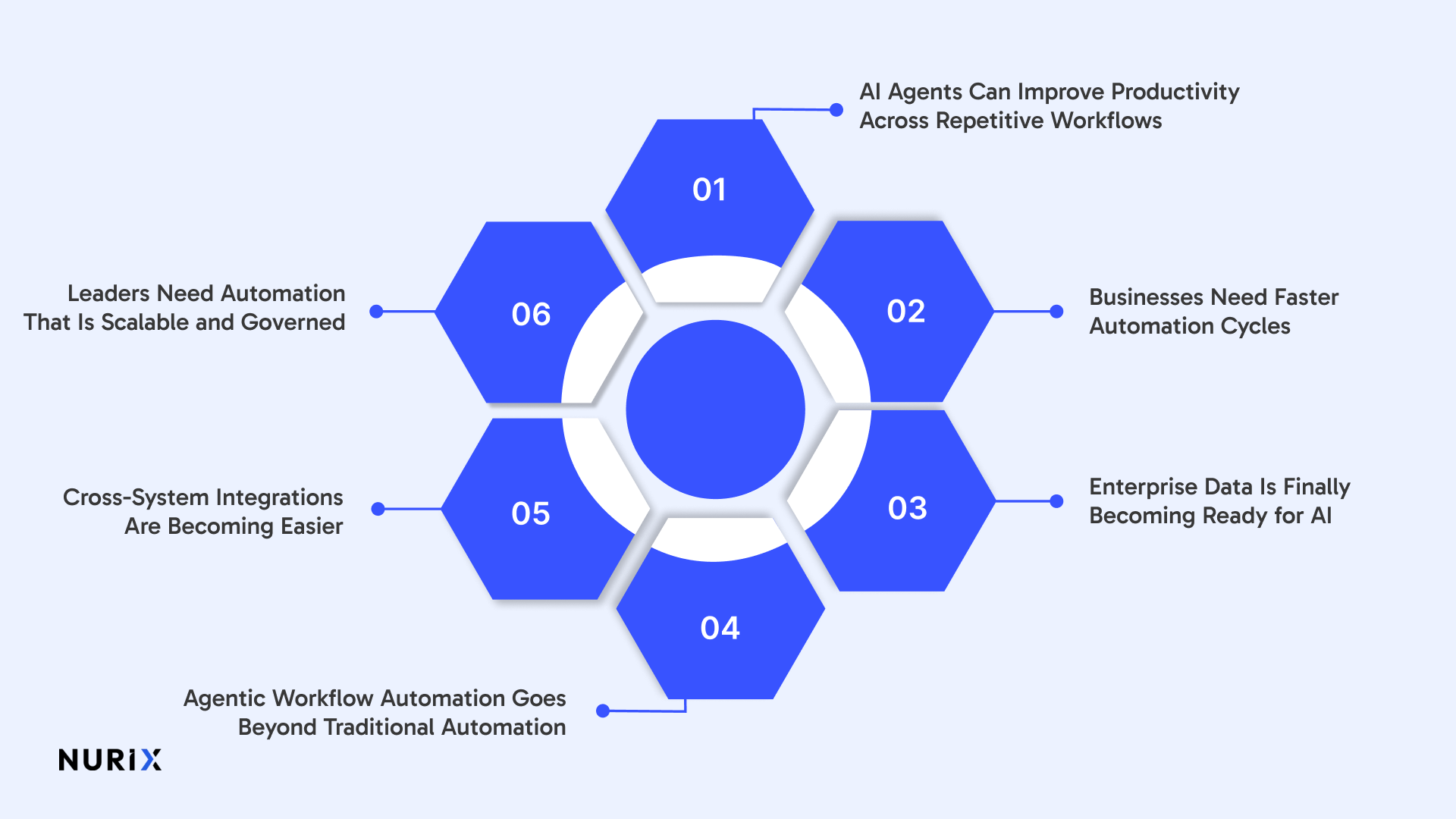
1. AI Agents Can Improve Productivity Across Repetitive Workflows
CIOs and COOs are under pressure to improve productivity without increasing headcount. AI agents can support this by handling repetitive, high-volume tasks that slow teams down every day.
For example, AI agents can help with:
- Qualifying inbound leads through voice or chat conversations.
- Routing sales-ready leads to the right sales team.
- Summarizing support calls and chat tickets before human handoff.
- Updating customer records across systems.
- Generating operational reports.
- Validating data before it enters core workflows.
2. Businesses Need Faster Automation Cycles
Many enterprise automation projects take months to design, approve, build, and deploy. That pace is difficult when customer expectations, sales cycles, and operational demands keep changing.
AI agents can help teams move faster through:
- Low-code or no-code configuration.
- Faster workflow testing.
- Reusable automation patterns.
- Easier updates when business rules change.
- Quicker deployment across teams and functions.
For Enterprise Architects, this matters because agentic AI can become part of the broader enterprise architecture, not another disconnected tool.
3. Enterprise Data Is Finally Becoming Ready for AI
AI agents need reliable business data to act correctly. Many enterprises are now better prepared because they have stronger data warehouses, data lakes, application programming interfaces, and internal knowledge bases.
This gives agents the context they need to:
- Retrieve customer information.
- Check policy rules.
- Compare documents.
- Review account history.
- Trigger the right workflow.
4. Agentic Workflow Automation Goes Beyond Traditional Automation
Traditional robotic process automation is useful for repetitive, rules-based tasks. But it often struggles when workflows require judgment, context, or exception handling.
AI agents add more flexibility because they can:
- Understand intent from voice, chat, or workflow inputs.
- Reason through next steps.
- Take multi-step actions.
- Use enterprise tools.
- Escalate complex cases to humans.
5. Cross-System Integrations Are Becoming Easier
Enterprise work rarely happens in one system. A customer may call about an order, ask a question in chat, or request an account change. That single request may touch a customer relationship management platform, a helpdesk, a billing system, an inventory tool, and a reporting dashboard.
Modern connectors and application programming interfaces make it easier for AI agents to:
- Read data from enterprise resource planning systems.
- Trigger actions in customer relationship management platforms.
- Update inventory systems.
- Create reports in business intelligence tools.
- Send full context to human teams during escalation.
This is where NuPlay by Nurix AI integration layer becomes important. Nurix supports 400+ integrations. Its agents can retrieve data, update records, and close the loop inside the tools your teams already use, including systems such as Salesforce, HubSpot, Zoho CRM, Genesys Cloud, Talkdesk, Zoom Phone, Slack, Microsoft Teams, Google Calendar, and Calendly.
6. Leaders Need Automation That Is Scalable and Governed
Enterprise leaders cannot scale AI agents safely without control. Agents need clear permissions, audit trails, monitoring, escalation rules, and data protection.
This is why agentic AI adoption should not be treated as a standalone tool. It should be planned as part of the enterprise operating model.
For automation heads or enterprise architects, the priority is clear: identify the right workflows, connect the right systems, and ensure every agent operates with visibility and governance.
This shift becomes clearer when you look at how agents are already being used inside enterprise apps to handle real work across teams, systems, and customer channels.
What AI Agents Can Do in Enterprise Apps
Enterprise apps are using agentic AI to move from simple data storage to active workflow execution. Instead of only showing information, these apps can now use AI agents to understand requests, retrieve data, trigger actions, update records, and escalate complex cases.
Here are the key industry use cases:
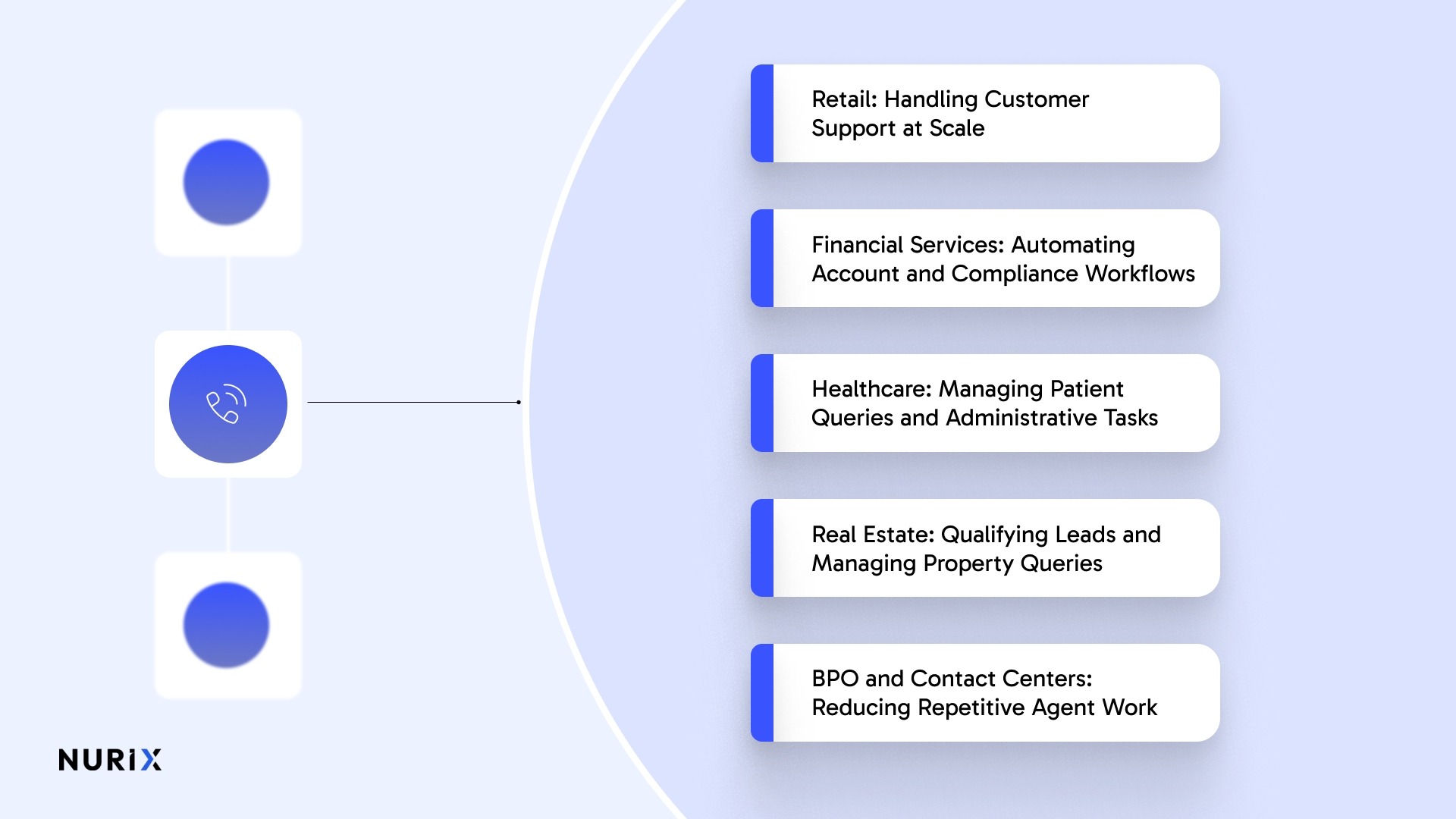
1. Retail: Handling Customer Support at Scale
Retail teams deal with thousands of questions about orders, returns, refunds, delivery delays, and product availability. Agentic AI can help your support apps handle these requests through voice and chat agents.
For example, an AI agent can check order status, update delivery details, process a return request, and escalate only the complex cases to a human agent. This helps reduce wait times during peak seasons and improves customer satisfaction.
2. Financial Services: Automating Account and Compliance Workflows
Banks, lenders, and financial service providers handle high volumes of account queries, payment issues, document checks, and compliance requests. Agentic AI can help your apps verify customer intent, retrieve account data, flag exceptions, and support secure workflows.
For example, an AI agent can help with loan application follow-ups, account servicing, payment reminders, and document validation while keeping human approval for high-risk decisions.
3. Healthcare: Managing Patient Queries and Administrative Tasks
Healthcare teams face constant pressure from appointment requests, billing questions, insurance checks, and patient follow-ups. Agentic AI can help your systems respond more quickly while keeping sensitive workflows secure.
An AI agent can schedule appointments, answer common billing questions, route urgent requests, and send context to the right care or admin team. This helps reduce administrative load without removing human oversight.
NuPlay by Nurix AI applies this through AI agents for health and fitness teams, handling appointment scheduling, follow-ups, recall automation, lead qualification, smart routing, and frequently asked questions across channels like phone, WhatsApp, web chat, SMS, and email.
We also support integrations with electronic medical records, customer relationship management systems, scheduling tools, and patient management platforms, with privacy-focused configurations for HIPAA and regional compliance needs.
4. Real Estate: Qualifying Leads and Managing Property Queries
Real estate teams often lose leads due to slow or manual follow-up. Agentic AI can help your customer relationship management system qualify buyers, answer property questions, schedule viewings, and route serious leads to sales teams.
A voice agent can speak with inbound leads, understand their budget and location preferences, and book appointments directly into your sales calendar.
5. BPO and Contact Centers: Reducing Repetitive Agent Work
Business process outsourcing teams and contact centers manage high volumes of queries across multiple clients and channels. Agentic AI can help your teams automate routine conversations, summarize interactions, and improve routing.
For example, an AI agent can handle first-level support, verify customer intent, create tickets, update records, and pass full context to a human agent when escalation is needed. This helps improve efficiency without lowering service quality.
Once AI agents start handling real work within enterprise apps, the next question is whether that work creates measurable business value.
Also Read: AI for Real Estate Lead Qualification: Tools & Use Cases
How to Measure Enterprise AI ROI
Agentic AI adoption should not be measured only by how many agents you deploy. The real question is whether agents improve speed, reduce costs, increase accuracy, and enhance the customer experience across high-volume workflows.
Enterprise AI ROI becomes clearer when you connect agent performance to business outcomes.
Here are the key metrics to track:
- Cost per Interaction: Measure how much it costs to resolve a support request, sales inquiry, or internal ticket before and after AI agent deployment. This helps you see whether agents are reducing manual workload.
- Resolution Time: Track how quickly customers or employees get answers and complete actions. Faster resolution shows that agents are removing delays from workflows.
- Containment Rate: Measure how many requests are resolved without human handoff. A higher containment rate shows that agents can handle more routine work independently.
- Lead Response Time: Track how quickly inbound leads are qualified, routed, and followed up. This helps connect agentic AI to pipeline efficiency.
- Escalation Quality: Do not only measure fewer escalations. Measure whether escalated cases include full context, summaries, and next-step recommendations for human teams.
- Employee Productivity: Track how much time teams save on repetitive tasks like ticket summaries, record updates, document review, and data validation.
For automation heads, the goal is not just automation. The goal is measurable AI transformation: lower operational effort, faster workflows, better customer experience, and stronger governance.
This is where NuPulse becomes useful. NuPulse gives teams complete visibility into agent performance and key business metrics, including response time, containment, resolution rate, intent accuracy, and escalation frequency.
But ROI only becomes real when the deployment can scale safely across systems, teams, and workflows.
The Hidden Challenges Slowing Agentic AI Adoption
Agentic AI adoption slows down when enterprises move from pilots to real workflows without the right data, integrations, governance, and monitoring. For high-volume enterprises, the real challenge is making AI agents reliable enough to work across daily operations.
Here are the key challenges slowing agentic AI adoption:
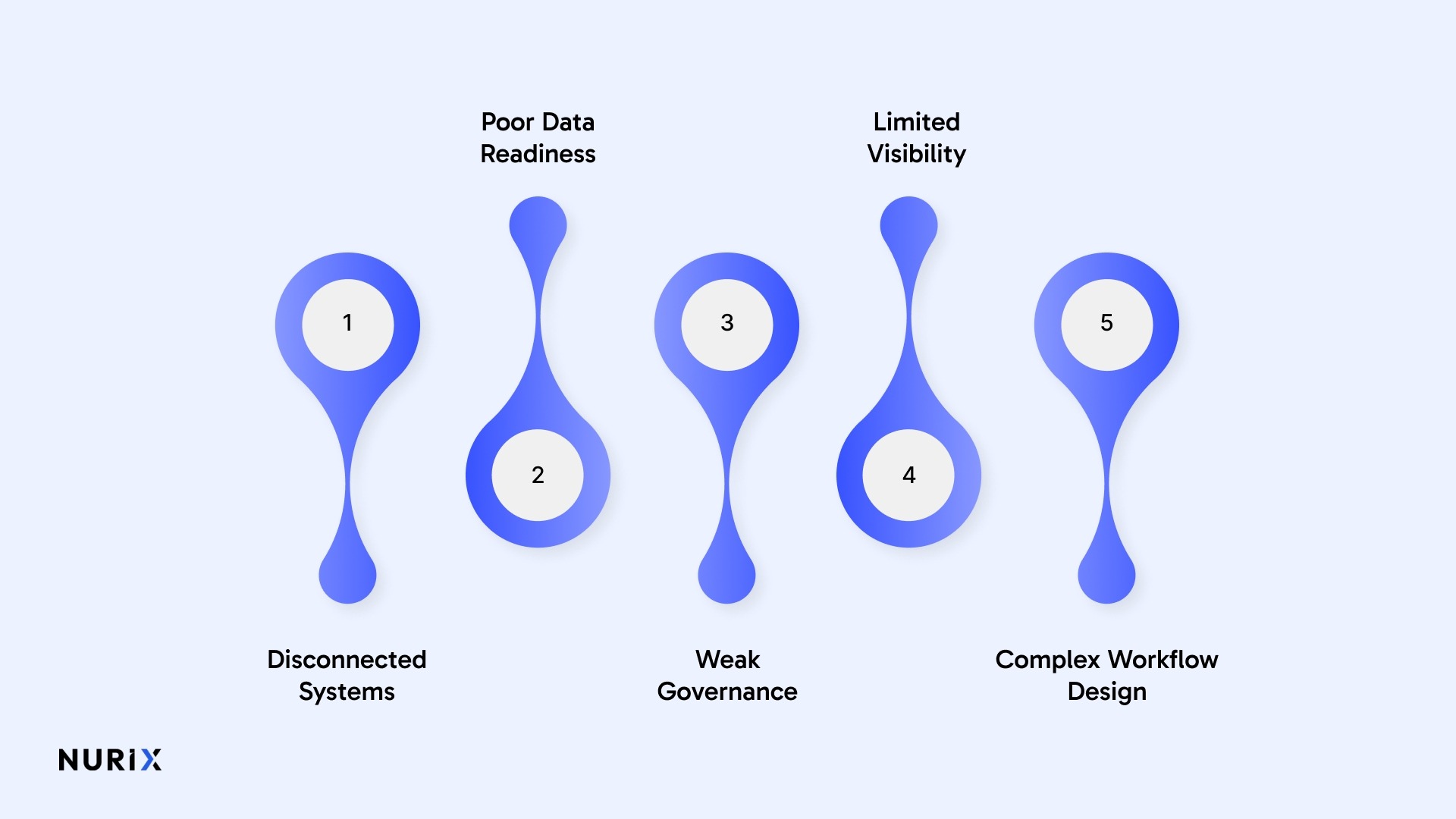
- Disconnected Systems: AI agents need access to customer records, support tools, enterprise resource planning systems, and internal knowledge bases. Without integration, they cannot complete tasks end-to-end.
- Poor Data Readiness: Agents need clean, current, and approved data to make accurate decisions. If your data is scattered or outdated, agent performance will suffer.
- Weak Governance: AI agents need clear permissions, approval rules, audit trails, and escalation paths. Without governance, scaling agents can create security and compliance risks.
- Limited Visibility: Enterprise leaders need to know how agents perform in real time. Without monitoring, it is hard to track failures, handoffs, resolution rates, and customer impact.
- Complex Workflow Design: Many enterprise workflows involve exceptions, approvals, and multiple teams. If the workflow is not mapped clearly, agents may struggle to act safely and accurately.
These challenges do not mean enterprises should slow down adoption. They mean agentic AI needs the right foundation: orchestration, integrations, monitoring, and governance from day one.
Also Read: 20 Key Metrics to Evaluate Your AI Chatbot Performance
How NuPlay by Nurix AI Helps Enterprises Scale Agentic AI
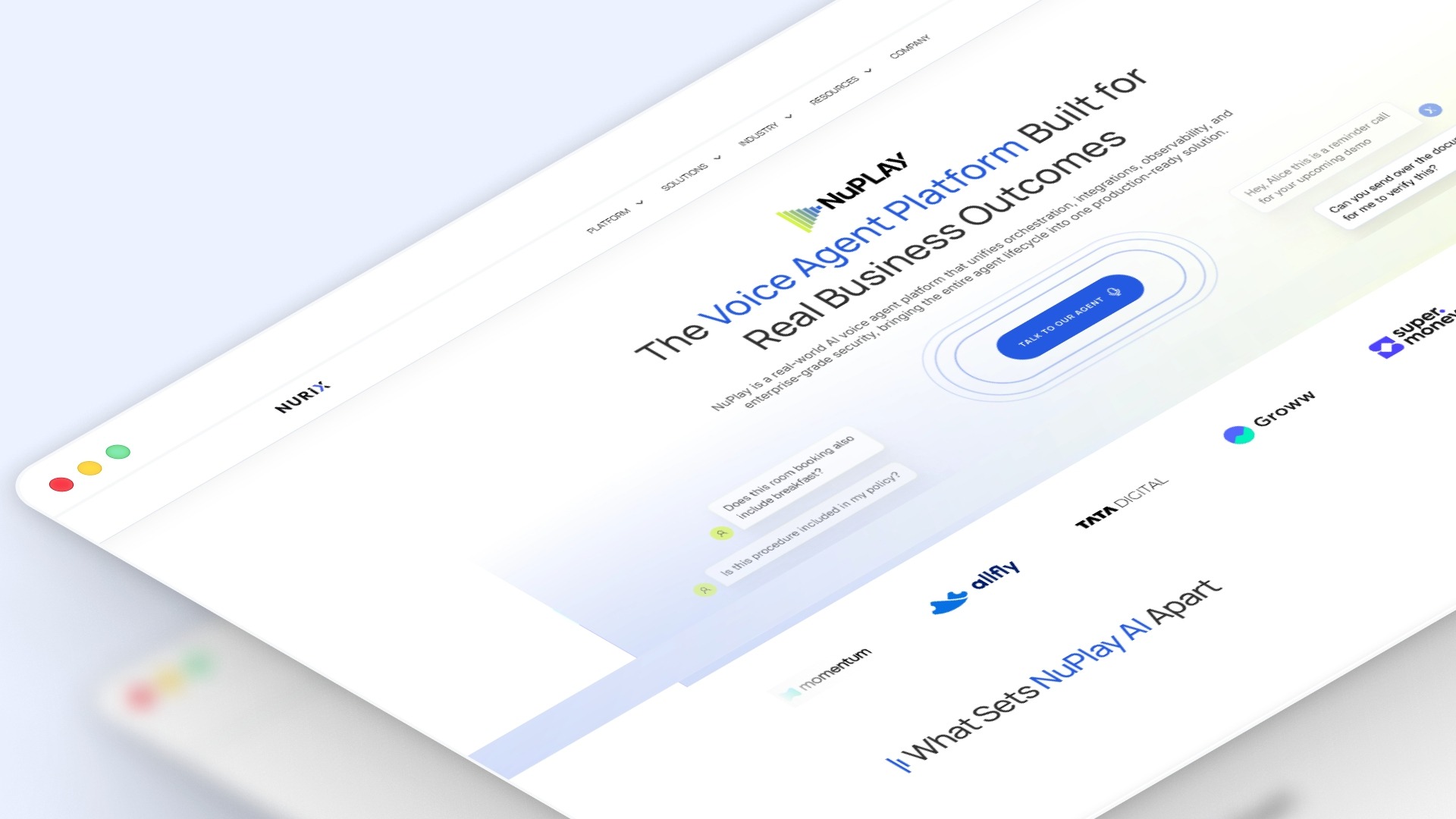
NuPlay by Nurix AI helps you move agentic AI from isolated pilots to enterprise-grade deployment. For high-volume enterprises, this means your agents can be designed, deployed, monitored, and governed across voice, chat, documents, and backend systems.
Instead of relying on one generic AI assistant, NuPlay gives you the foundation to build specialized agents that can understand context, take action, and improve over time.
Here are the key ways NuPlay supports scalable agentic AI adoption:
1. Agent Design: Build Agents That Fit Your Business
NuPlay by Nurix AI supports model-agnostic execution, so you can choose models based on accuracy, latency, or cost. It also includes brand-aligned voice control, Retrieval-Augmented Generation, and knowledge synthesis.
This helps you build agents that reflect your brand, use approved business knowledge, and deliver accurate responses without being locked into one model.
2. Agent Deployment: Orchestrate Specialized Agents
Enterprise workflows are rarely simple. A single request may involve intent detection, data retrieval, system updates, and escalation.
Our multi-agent orchestration, where specialized agents work under a central orchestrator. With dynamic routing, 400+ integrations, and parallel task execution, teams can improve task accuracy, reduce cost to serve, and resolve more requests without human handoff.
3. Monitoring and Optimization: Improve Agents With NuPulse
Once agents are live, you need real-time visibility into how they perform. NuPulse tracks metrics such as response time, containment, resolution rate, conversation logs, and customer friction points.
This gives your teams actionable insights to identify issues, improve workflows, and continuously optimize agent performance.
4. Security and Compliance: Scale With Control
Agentic AI adoption needs strong governance, especially when agents handle customer data or sensitive workflows.
Our security and compliance support Personally Identifiable Information redaction, configurable data retention, audit trails, observability, role-based access control, single sign-on, and data residency options. This helps protect sensitive data and keeps AI agent operations audit-ready.
5. Brand Voice Intelligence: Make Agents Sound Like You
NuRep helps agents learn from your content, guidelines, and customer-facing materials. It gives you control over tone, persona, and voice across different markets and industries.
This matters because voice and chat agents are often the first point of contact for customers. A brand-aligned agent can create more natural, trusted, and consistent interactions.
Conclusion
Agentic AI adoption is moving enterprise applications from passive systems to active workflow engines. For high-volume enterprises, this shift can reduce manual handoffs, speed up support and sales workflows, and improve how teams handle repetitive requests.
But adoption will only scale if your agents have the right data, integrations, orchestration, monitoring, and governance behind them. That is where NuPlay by Nurix AI fits.
NuPlay by Nurix AI is positioned as an enterprise-grade conversational AI platform for building and deploying voice and chat agents across support, sales, and business workflows. It brings orchestration, integrations, observability, and enterprise-grade security into one production-ready platform, helping enterprises move from AI pilots to real operational impact.
If you are preparing your enterprise applications for agentic AI adoption, now is the time to start with the right platform. Schedule a custom demo to see how voice and chat agents can support your workflows at scale!