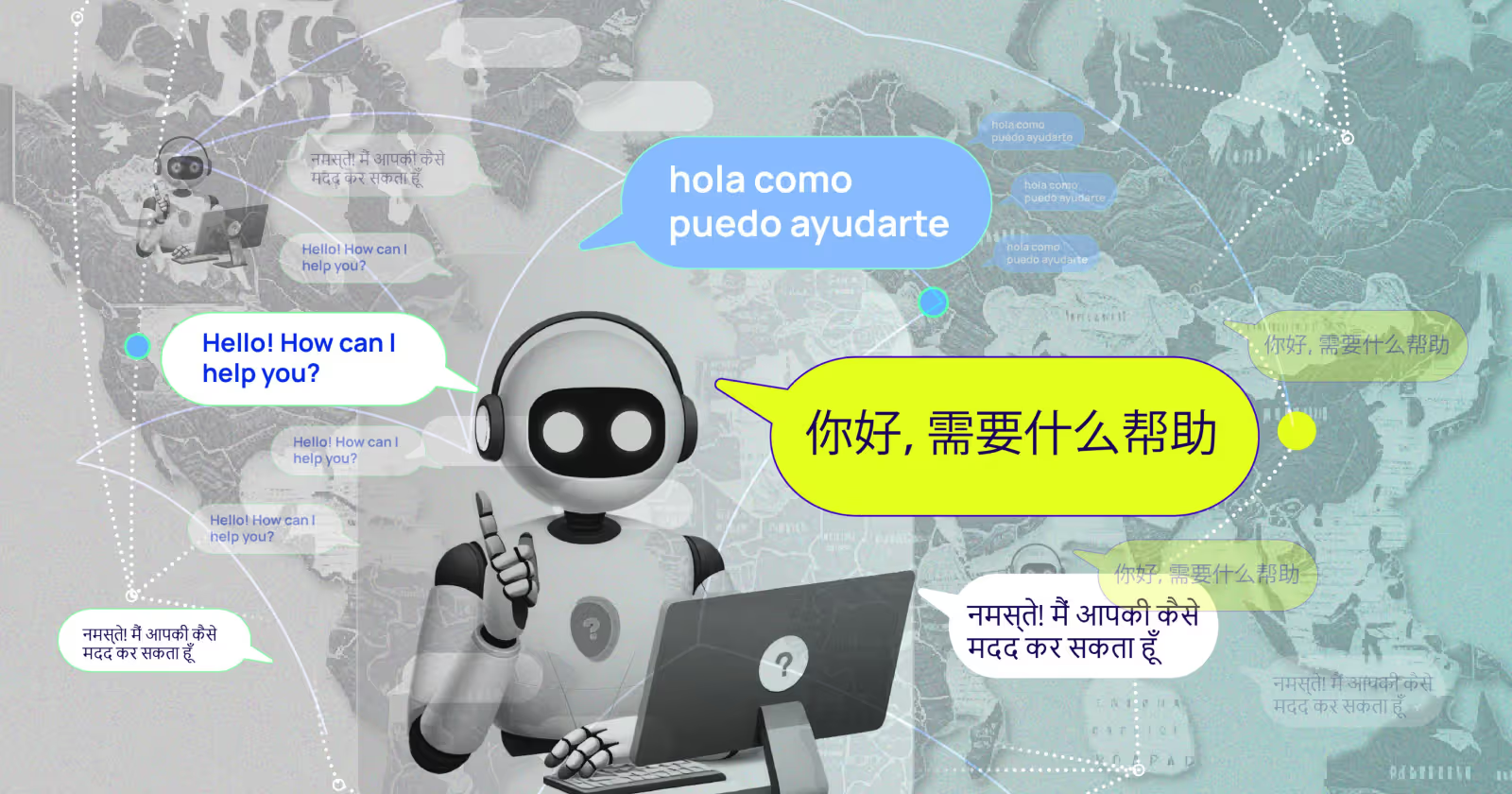

Enterprises are beginning to explore AI systems that act less like assistants and more like digital workers executing operational tasks. New platforms are emerging that can plan tasks, coordinate multiple models, and execute workflows across real software environments.
On February 25, 2026, Perplexity AI introduced Perplexity Computer, a multi-agent system that orchestrates work across 19 models in parallel, breaks complex projects into subtasks, and delegates them to specialized agents.
The launch attracted attention because it showed AI acting as a digital worker, capable of executing operational tasks through existing software interfaces.
In this blog, you’ll explore what multi-agent orchestration means for enterprise operations and how organizations can evaluate AI agent platforms built for real business workflows.
Executive Summary: Perplexity Computer shows how multi-agent systems can coordinate multiple AI models to execute complex workflows across software environments. For enterprises, the launch signals a shift from prompt-based AI assistance to task-executing digital workers. It also highlights why orchestration, integrations, observability, and governance matter when evaluating AI agents for production workflows.
Key Takeaways:
- Perplexity introduced a Digital Worker Architecture: Perplexity Computer coordinates 19 AI models to plan tasks and execute multi-step workflows autonomously.
- Multi-Agent Orchestration Enables Complex Automation: AI systems can now coordinate reasoning, retrieval, and execution across multiple agents.
- Enterprise Workflows Are a Major Target for AI Agents: Multi-agent systems can automate support operations, document processing, internal service requests, and reporting.
- Digital Workers Differ From Enterprise AI Agents: General-purpose AI workers demonstrate automation potential but lack the governance and reliability enterprises require.
- Enterprises Must Evaluate Orchestration Platforms Carefully: Production deployments require integration, workflow reliability, and enterprise control mechanisms.
What Is the “Digital Worker” Concept Behind Perplexity Computer?
Perplexity AI describes Perplexity Computer as a “digital worker.” It means an AI system is designed to perform tasks through the same software environments used by human workers.
This concept reflects a shift from AI assistants that answer questions to AI agents that carry out tasks across systems.
Below are the key characteristics of the digital worker model.
1. Interaction Through Existing Software Interfaces
Perplexity Computer is designed to operate through the same software interfaces used by human workers. The system interacts with applications, tools, and data environments where work normally happens.
This approach matters because AI agents can participate directly in operational workflows rather than being limited to separate chatbot tools.
2. Task Execution Instead of Prompt Responses
The digital worker concept focuses on completing tasks rather than answering questions. The system interprets an objective, identifies the steps required, and executes the actions needed to reach the outcome.
This shift from prompt responses to task execution matters for organizations evaluating AI agents that automate operational work.
3. Coordination of Multiple AI Capabilities
Digital worker systems combine several capabilities, including reasoning, retrieval, and generation, across AI models. By coordinating specialized models, the system can handle complex tasks that require different types of processing. This architecture reflects how multi-agent systems can support more advanced enterprise automation.
4. Participation in Multi-Step Workflows
The digital worker model enables AI systems to participate in workflows spanning multiple steps and tools. The system gathers information, generates results, and moves the process forward.
This ability to operate across workflow stages plays a central role in enterprises' evaluation of AI agent platforms for operational automation.
To understand how AI agents can perform real operational work, explore Understanding Virtual AI Agents and Their Impact to see how autonomous systems are changing enterprise workflows.
The digital worker concept relies on systems that can coordinate multiple AI capabilities. One of the core technologies that enables this coordination is multi-agent orchestration.
How Does Multi-Agent Orchestration Work in AI Systems?
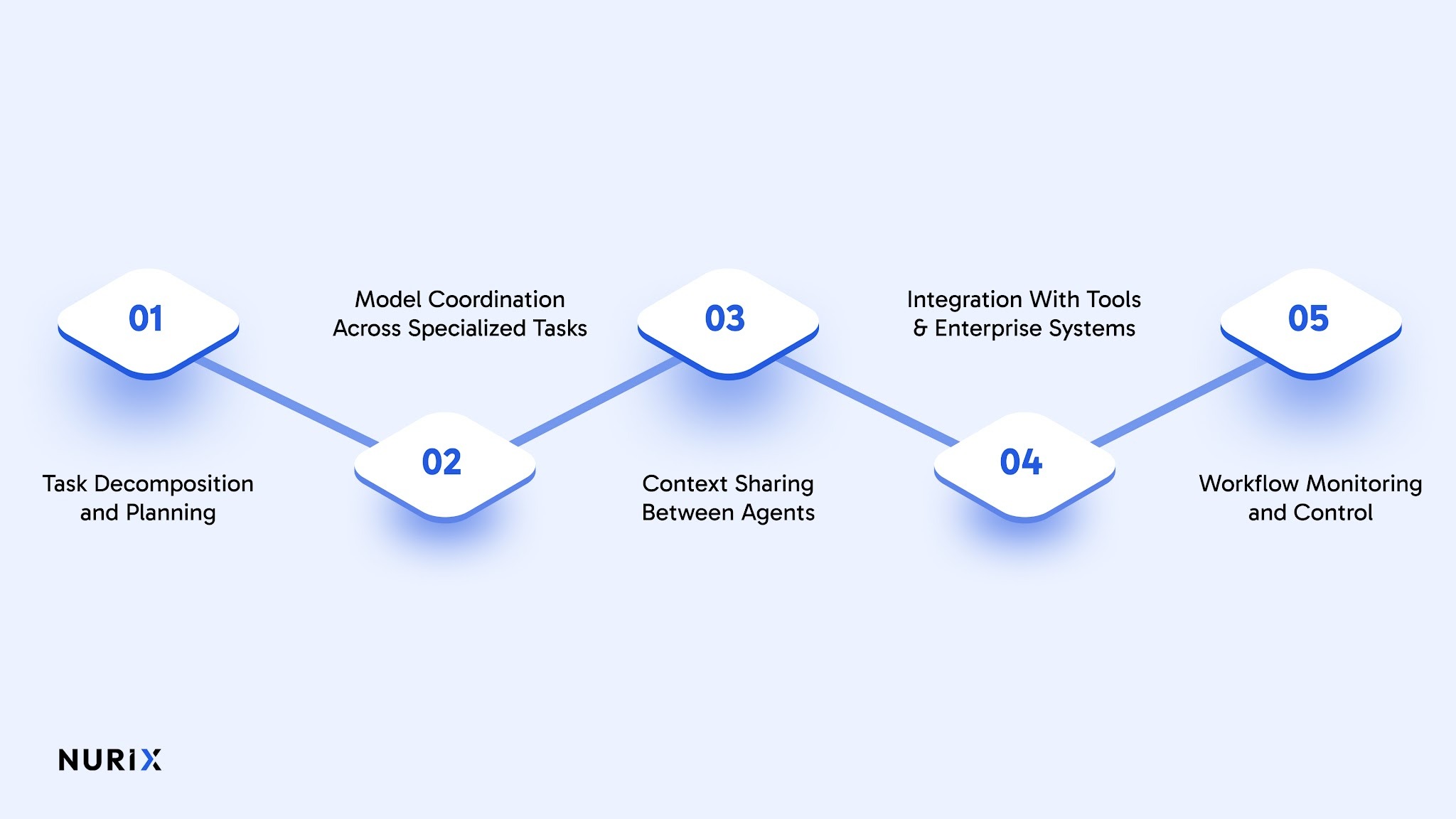
Multi-agent orchestration allows AI systems to coordinate multiple models and tools to complete complex tasks automatically. The system assigns different parts of a task to specialized agents and manages how those agents share information and execute steps.
Here's how multi-agent orchestration works in AI systems:
1. Task Decomposition and Planning
Multi-agent orchestration begins by breaking a high-level objective into smaller operational steps. A planning layer interprets the request, identifies the tasks required to complete it, and determines the execution sequence.
This planning process allows the system to organize complex work before it assigns tasks to different agents.
2. Model Coordination Across Specialized Tasks
Different AI models handle different parts of a workflow based on their capabilities. One model may handle reasoning, another may retrieve knowledge, and another may generate outputs or trigger actions. The orchestration layer coordinates these models so that outputs from one step become inputs to the next.
3. Context Sharing Between Agents
Agents must share information across workflow steps to complete complex tasks accurately. Context can include task objectives, retrieved data, and intermediate outputs generated by earlier agents. Maintaining this shared context ensures each stage of the workflow builds on previous results.
4. Integration With Tools and Enterprise Systems
Multi-agent orchestration often includes connectors that allow agents to interact with external systems such as CRM platforms, knowledge bases, and internal applications.
This allows agents to retrieve information, update records, or execute actions during a workflow. Integration determines whether the system can operate inside real operational environments.
5. Workflow Monitoring and Control
An orchestration layer tracks execution across agents to ensure tasks finish in the correct order. It monitors progress, handles errors, and determines when human review is required. This control layer provides visibility into automated workflows and helps maintain operational reliability.
To understand how operational automation delivers measurable impact across workflows, see 5 Powerful Ways Conversational AI Solutions Quietly Cut Service Costs.
The mechanics of multi-agent orchestration directly influence the types of workflows it can impact in enterprise settings.
Which Enterprise Workflows Can Multi-Agent Orchestration Impact?
Multi-agent orchestration allows AI systems to coordinate planning, reasoning, data retrieval, and action execution across multiple steps. This capability enables automation of workflows that typically require coordination across several tools, teams, and systems.
Below are the enterprise workflows that can be impacted by multi-agent orchestration.
1. Customer Support Operations
AI agents can automate routine support requests such as order tracking, account updates, or subscription changes. The system retrieves information from support platforms, understands the request, and completes the action without manual intervention.
2. Sales Lead Qualification and Routing
AI agents can manage early-stage lead qualification by collecting information, assessing intent, and routing qualified opportunities to sales teams. The system can update Customer Relationship Management (CRM) records, schedule meetings, and trigger follow-up actions.
3. Document Processing and Knowledge Work
Enterprise workflows often require teams to review documents, extract key data, and create summaries or responses. Multi-agent systems can retrieve documents, analyze content, and generate structured outputs for tasks such as contract review, research briefs, or RFP responses.
4. Internal Service Requests
Organizations manage large volumes of internal requests across HR, IT, and operations teams. AI agents can retrieve policies, update records, and route requests to the right systems. Multi-agent orchestration enables these tasks to integrate information retrieval, decision rules, and system updates into a single workflow.
5. Data Retrieval and Operational Reporting
Many enterprise processes require teams to collect data from multiple systems and generate reports or insights. AI agents can retrieve information from databases, compile results, and produce structured outputs for operational reviews.
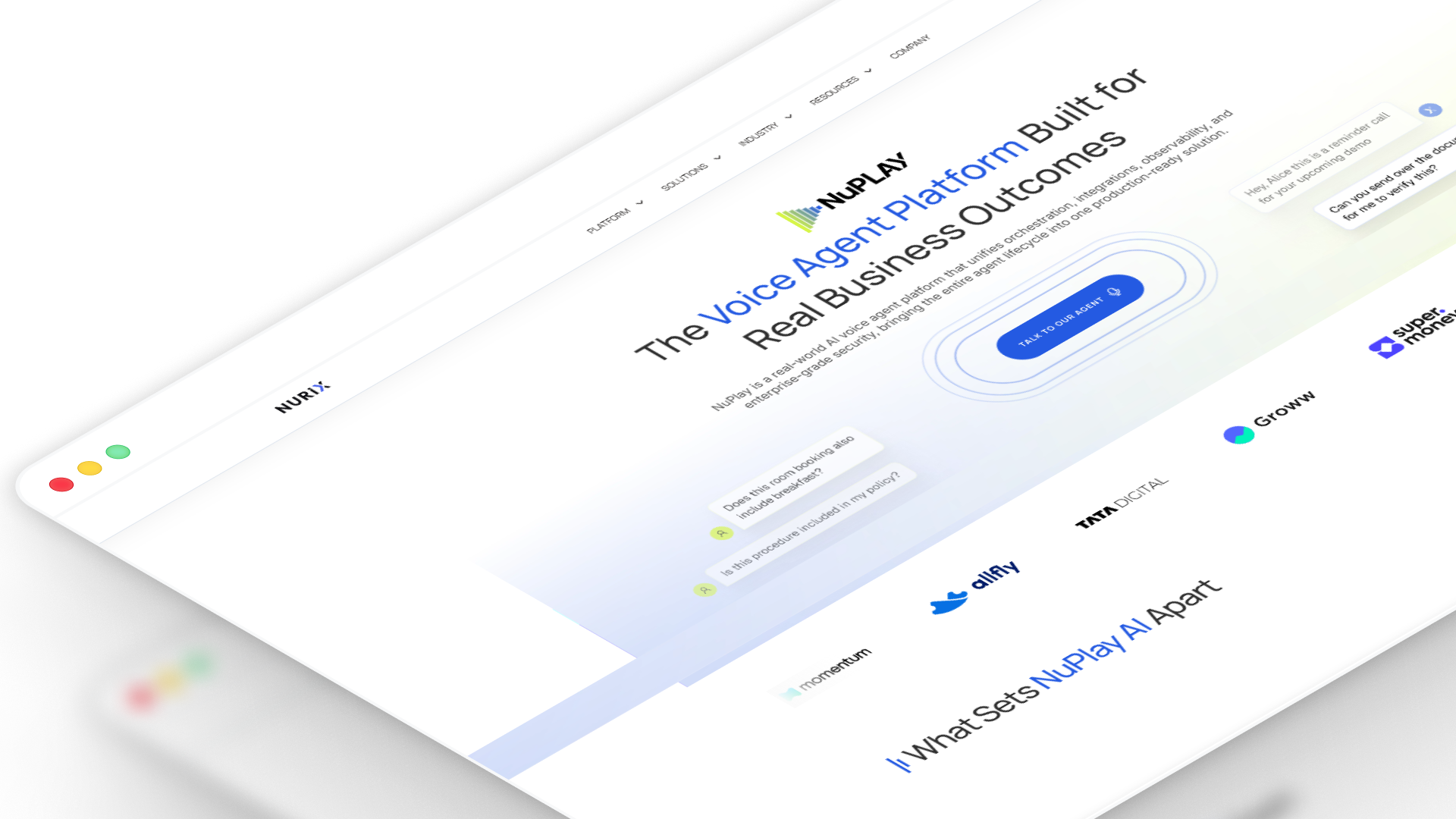
Platforms like NuPlay by Nurix AI, an enterprise-grade voice and chat AI platform that unifies orchestration, integrations, observability, and enterprise-grade security, apply similar orchestration principles to automate sales, support, and operational workflows across connected systems.
Examining the workflows affected by multi-agent orchestration helps clarify how general AI digital workers differ from enterprise AI agents.
How Do General AI Digital Workers Compare with Enterprise AI Agents?
General AI digital workers are designed to perform a wide range of tasks across different environments. Enterprise AI agents, in contrast, are built to execute specific operational workflows inside business systems.
While general AI digital workers show what autonomous AI systems can do, enterprises usually need agents built specifically for operational environments. Production deployments require integration, reliability, and governance that go beyond experimental AI automation tools.
Understanding this difference helps organizations evaluate whether a platform can support real operational automation.
Comparing general AI digital workers with enterprise AI agents highlights what the Perplexity Computer signals for broader AI adoption in enterprises.
What Does Perplexity Computer Signal for Enterprise AI Adoption?
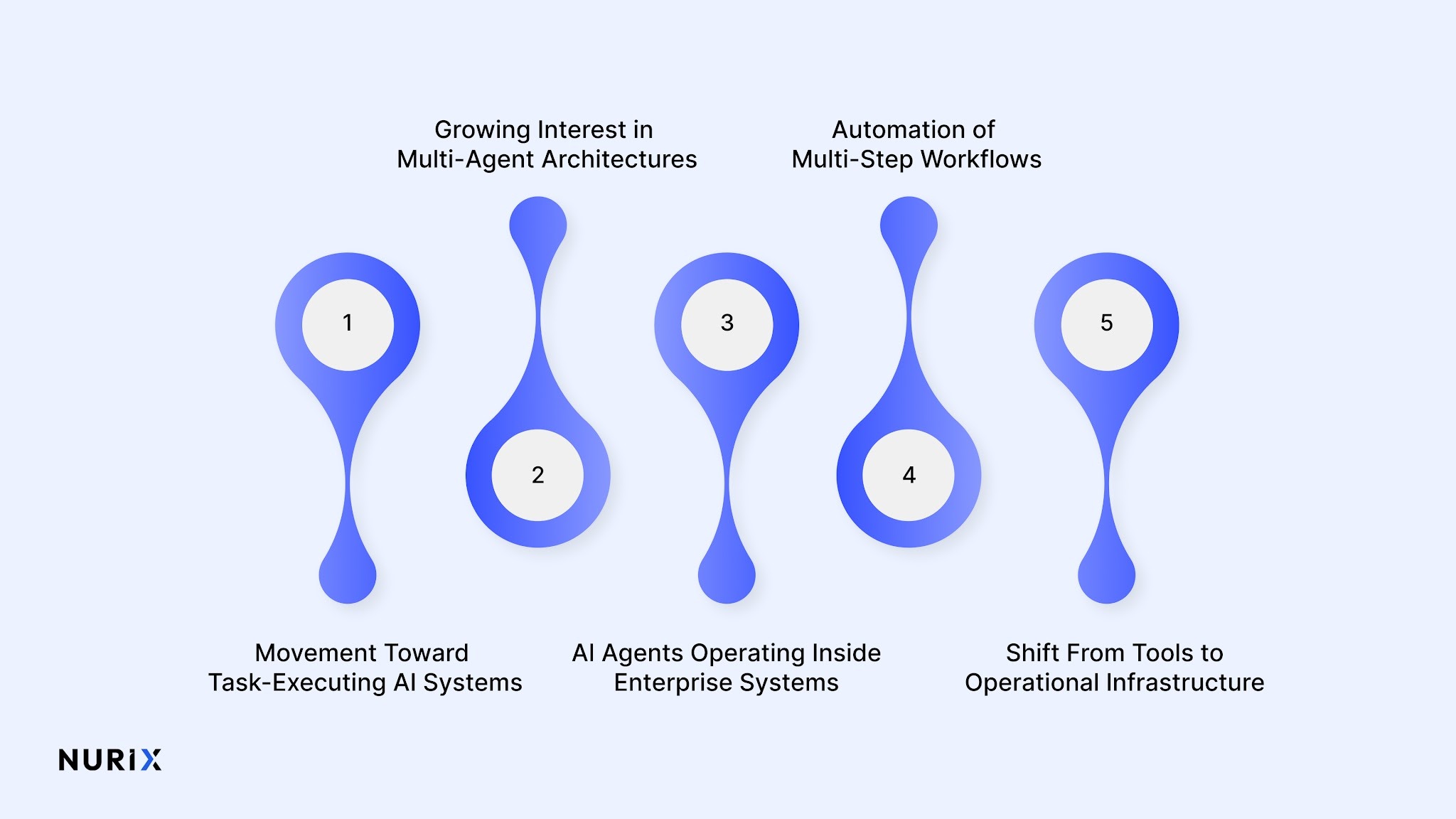
The launch of Perplexity Computer highlights a shift in how AI systems are now being designed for operational work. Instead of focusing only on prompt responses or content generation, newer platforms aim to coordinate models, interact with tools, and execute tasks across digital workflows.
Here’s what the Perplexity Computer signals for enterprise AI adoption:
1. Movement Toward Task-Executing AI Systems
AI systems are moving beyond conversational assistants and becoming platforms that execute work. Multi-agent architectures allow systems to plan tasks, coordinate models, and perform actions across software environments. This shift shows that AI platforms are increasingly built to support operational automation.
2. Growing Interest in Multi-Agent Architectures
Platforms that coordinate multiple AI models are gaining attention because complex tasks often require different capabilities, such as reasoning, retrieval, and generation.
Multi-agent orchestration allows these capabilities to work together within a structured workflow. This architecture supports automation of processes that a single model cannot complete on its own.
3. AI Agents Operating Inside Enterprise Systems
Enterprise adoption depends on whether AI agents can operate inside existing business systems. Platforms that interact with applications, data sources, and workflow tools can automate tasks that usually require manual coordination. This capability matters for organizations that want to integrate AI into operational processes.
4. Automation of Multi-Step Workflows
Many enterprise tasks involve several steps, such as retrieving information, generating outputs, and triggering follow-up actions. Multi-agent systems can coordinate these steps within a single workflow. This allows organizations to automate processes that previously required human supervision at each stage.
5. Shift From Tools to Operational Infrastructure
The direction of AI platform development is moving from standalone tools toward infrastructure that supports automated workflows across the enterprise. Platforms that coordinate agents, systems, and data sources may become core components in enterprise automation strategies.
To see how agentic AI drives measurable business results, explore How Agentic AI Is Boosting Sales Conversions and learn how multi-agent systems can increase operational efficiency and revenue outcomes.
Final Thoughts
Perplexity Computer shows how AI systems are moving beyond conversational assistants to become digital workers capable of executing complex operational tasks.
Multi-agent orchestration lets AI platforms coordinate models, interact with software systems, and complete multi-step workflows. For enterprise leaders evaluating automation strategies, this shift signals a new phase of AI adoption focused on operational execution.
Enterprise platforms such as NuPlay by Nurix AI bring these concepts into production environments. NuPlay by Nurix AI powers 799,982 conversations every month, helping organizations achieve 65% cost savings, 80% automation coverage, and a 50% efficiency boost across sales and service workflows.
Ready to see how AI agents can automate enterprise operations? Schedule a demo to explore how NuPlay by Nurix AI powers enterprise-grade AI automation.
Author: Sakshi Batavia — Marketing Manager
Sakshi Batavia is a marketing manager focused on AI and automation. She writes about conversational AI, voice agents, and enterprise technologies that help businesses improve customer engagement and operational efficiency.



.jpg)
.jpg)