
Enterprise software still relies heavily on screens and dashboards, even as conversational AI continues to advance. Many organizations are exploring voice interfaces to simplify how users retrieve information and trigger workflows.
Recent reports indicate that OpenAI has unified its audio engineering, product, and research teams to focus on speech technologies and audio-first interfaces. The move signals that voice may become a primary way users interact with AI systems.
In this blog, you’ll explore what OpenAI’s audio strategy signals for enterprise voice AI and what production-grade voice AI agents require beyond consumer audio tools.
Key Takeaways:
- OpenAI’s Audio Strategy Signals a Shift Toward Voice Interfaces: OpenAI’s focus on speech models and audio-first systems indicates that voice is becoming a primary way users interact with AI.
- Voice Interfaces Are Moving Beyond Screens: Silicon Valley companies are exploring voice interfaces to simplify how users retrieve information and trigger actions across software systems.
- Voice AI Is Growing as an Enterprise Interaction Layer: Conversational AI enables employees and customers to access enterprise systems, retrieve data, and execute tasks through natural-language interactions.
- Consumer Voice Assistants Cannot Support Enterprise Workflows: Consumer voice tools lack the integrations, governance controls, and workflow capabilities required for enterprise automation.
- Enterprise Voice AI Requires Advanced Capabilities: Production-grade voice agents must integrate with enterprise systems, access operational data, and execute workflows reliably at scale.
What Is Driving OpenAI’s Shift Toward Audio-First AI Interfaces?
OpenAI is restructuring its development around speech and audio technologies to support AI systems designed for conversational interaction. Recent changes include the formation of unified audio teams and major improvements to speech models.
OpenAI is also reportedly developing an audio-first device designed for conversational interaction, which reflects a move toward voice-based interfaces replacing traditional screen interactions.
Here’s what is driving OpenAI’s move toward audio-first AI interfaces:
- Consolidation of Audio Engineering and Research: OpenAI combined speech, audio processing, and product teams to build speech recognition, reasoning models, and voice synthesis as one integrated system.
- Development of Audio-First AI Products: OpenAI is reportedly developing an audio-first device designed for conversational interaction, shifting AI usage from typed prompts toward spoken commands.
- Improved Real-Time Voice Processing: Advances in Speech-to-Text (STT), Natural Language Processing (NLP), and voice synthesis now enable AI systems to conduct real-time conversations with sub-second response times.
- Expansion of AI Into Voice-Based Use Cases: OpenAI is applying conversational AI to environments such as healthcare and customer support, where voice interactions naturally drive information retrieval and task execution.
- Demand for Conversational Interfaces in Enterprise Software: Enterprises are increasingly deploying AI systems that interact via voice and chat to automate customer conversations, service requests, and operational queries.
To see how enterprise systems put voice and conversational AI into action to automate real workflows and customer experiences, explore Why Automated Customer Experience Matters for High‑Growth Teams.
OpenAI's move toward audio-first AI reflects a broader trend in Silicon Valley toward adopting voice interfaces beyond traditional screens.
Why Is Silicon Valley Moving Beyond Screens to Voice Interfaces?
Silicon Valley’s leading AI companies are investing heavily in voice interfaces as conversational AI advances. Improvements in speech recognition and real-time language models are making natural voice interactions practical.
As a result, many technology companies are exploring voice-first interfaces that reduce reliance on screens and simplify how users access information and trigger actions.
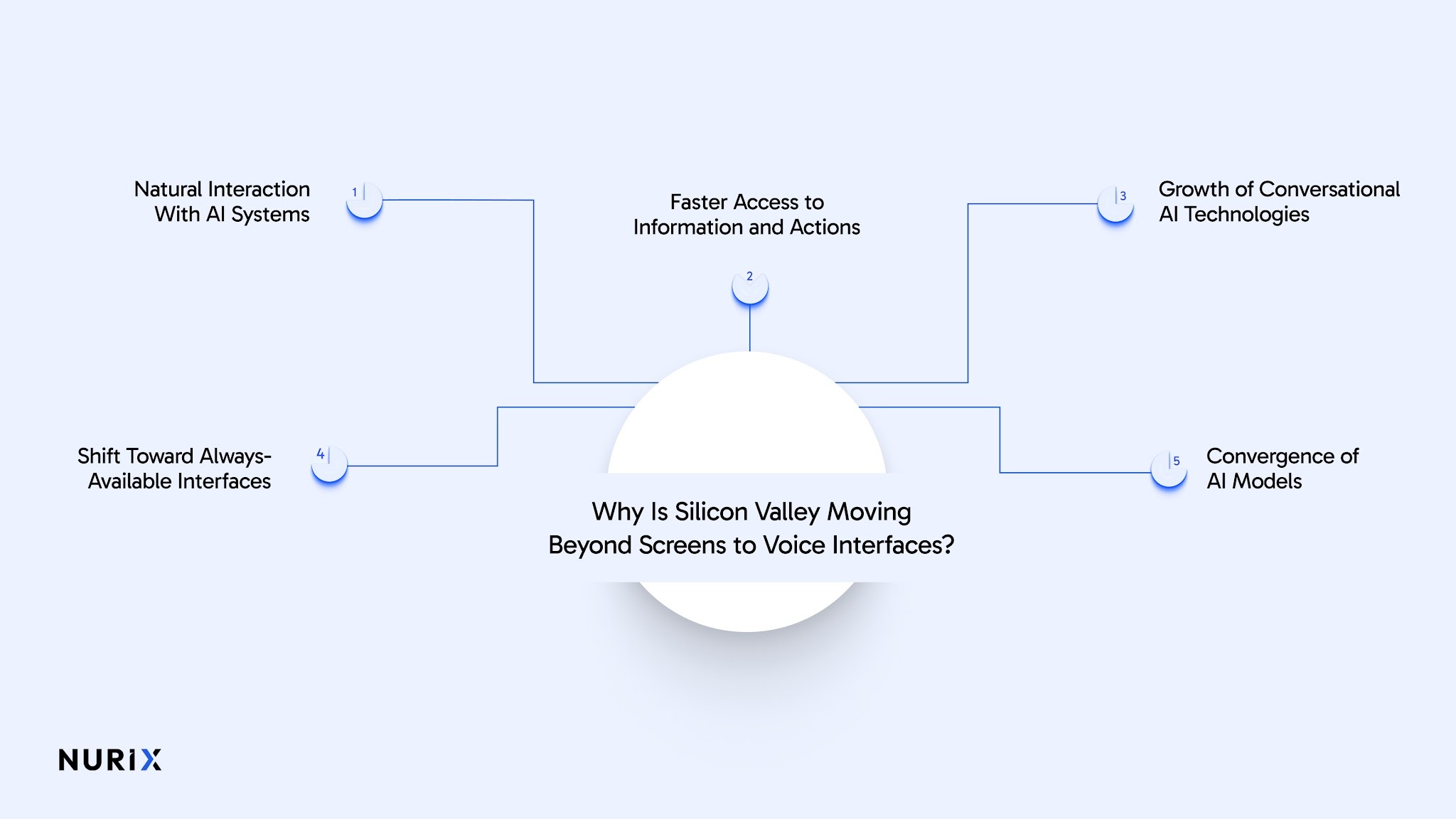
Here’s why Silicon Valley is moving beyond screens to voice interfaces:
1. Natural Interaction With AI Systems
Voice lets users interact with AI through natural conversation instead of typed commands. This reduces friction when accessing information or taking actions across software systems. In enterprises, conversational interfaces make it easier for employees and customers to use complex platforms.
2. Faster Access to Information and Actions
Voice interfaces let users request information and complete tasks without navigating dashboards or forms. A spoken request can retrieve data, update records, or start workflows in seconds. This approach is especially useful as organizations roll out AI across operational environments.
3. Growth of Conversational AI Technologies
Advances in speech recognition, natural language processing (NLP), and voice synthesis now support real-time conversations with AI. Modern voice AI can detect intent, keep context across dialogue, and generate natural responses. These abilities let voice interfaces handle operational workflows effectively.
4. Shift Toward Always-Available Interfaces
Voice systems let users interact with AI without screens or keyboards. This works well in environments where employees or customers need immediate answers during live interactions. As conversational AI improves, voice becomes a practical interface for enterprise systems.
5. Convergence of AI Models and Enterprise Data
Modern AI combines large language models with enterprise knowledge systems and operational tools. Voice interfaces let users query internal data, retrieve information, and trigger actions through conversation. This creates an interaction model where AI serves as an operational interface across enterprise platforms.
To understand how voice AI systems are evolving beyond basic speech recognition to deliver fluent, human‑like interactions that work across real workflows, explore How to Build Voice AI That Feels Human in Every Conversation.
As Silicon Valley embraces voice, OpenAI’s focus on audio highlights its growing role as the next interface for enterprises.
How OpenAI’s Audio Bet Signals Voice as the Next Enterprise Interface?
When a leading AI company like OpenAI reorganizes its research and product development around audio, it signals a broader shift in how AI systems will be used across industries.
OpenAI is investing heavily in speech models, conversational AI, and real-time voice technologies. These moves show that voice is becoming a main way to interact with AI systems.
Several developments highlight why OpenAI’s audio strategy points to a shift toward voice-based enterprise interfaces.
1. Voice Becomes the Interaction Layer for Enterprise Systems
Enterprise software usually relies on dashboards, forms, and complex navigation to get information or run workflows. Voice interfaces let users request information, complete tasks, and update records through conversation instead of clicking through screens. This changes how employees access enterprise systems and operational tools.
2. Conversational AI Moves From Experiments to Infrastructure
As AI companies invest in speech models and conversational systems, voice interaction is moving from experimental features to core capabilities. Enterprise platforms will increasingly include conversational AI and voice AI as standard ways to access data and services.
3. Enterprise Workflows Can Be Triggered Through Conversation
Voice AI agents can perform tasks like updating CRM records, routing support tickets, scheduling meetings, and retrieving operational data. Rather than just answering questions, conversational AI is becoming an operational interface that triggers enterprise workflows.
4. Voice Interfaces Improve Access to Enterprise Knowledge
Enterprise systems store large volumes of documentation, policies, and operational information that employees typically search for manually. Voice interfaces let users retrieve this knowledge instantly through conversational queries, making internal data more accessible.
5. Voice Enables Scalable Customer and Employee Interactions
Customer conversations, support requests, and internal service queries are naturally voice-based. Voice AI lets enterprises handle these interactions automatically while capturing structured data from each conversation.
For a closer look at how voice systems manage conversational context, timing, and decision logic capabilities that are essential for enterprise interfaces, check How Dialog Management Handles Real Conversations.
While voice is emerging as a key enterprise interface, consumer-grade voice assistants often fall short of meeting complex business workflow requirements.
Why Are Consumer Voice Assistants Not Suitable for Enterprise Workflows?
Consumer voice assistants were built for simple tasks like setting reminders, searching the web, or controlling devices. However, enterprise environments need systems that can carry out operational workflows across business platforms.
This difference shows why consumer voice technology can’t support enterprise automation. Below are the key limitations of consumer voice assistants include.
- Limited System Integration: Consumer assistants rarely connect directly to enterprise systems such as CRM, ERP, or support platforms, preventing them from performing real business workflows.
- Lack of Workflow Execution: Most consumer voice tools can answer questions, but can’t trigger actions such as updating records, routing tickets, processing requests, or scheduling service operations.
- Insufficient Context and Data Access: Enterprise interactions require access to internal knowledge bases, policy documents, customer records, and operational data, which consumer assistants usually can’t securely retrieve.
- Weak Governance and Compliance Controls: Enterprise environments require strict access control, audit logs, and regulatory compliance, capabilities that consumer voice platforms weren’t built to handle.
- Limited Reliability for Operational Tasks: Consumer assistants are designed for convenience tasks, not for high-volume operations such as support centers, sales pipelines, or enterprise service workflows.
For a deeper look at how enterprise‑grade voice AI and conversational systems (beyond simple voice tools) automate support and real business tasks, check Voicebot and Conversational AI for Customer Support.
The limitations of consumer voice assistants highlight the advanced capabilities that enterprise voice AI agents need to support business workflows effectively.
What Capabilities Do Enterprise Voice AI Agents Require?
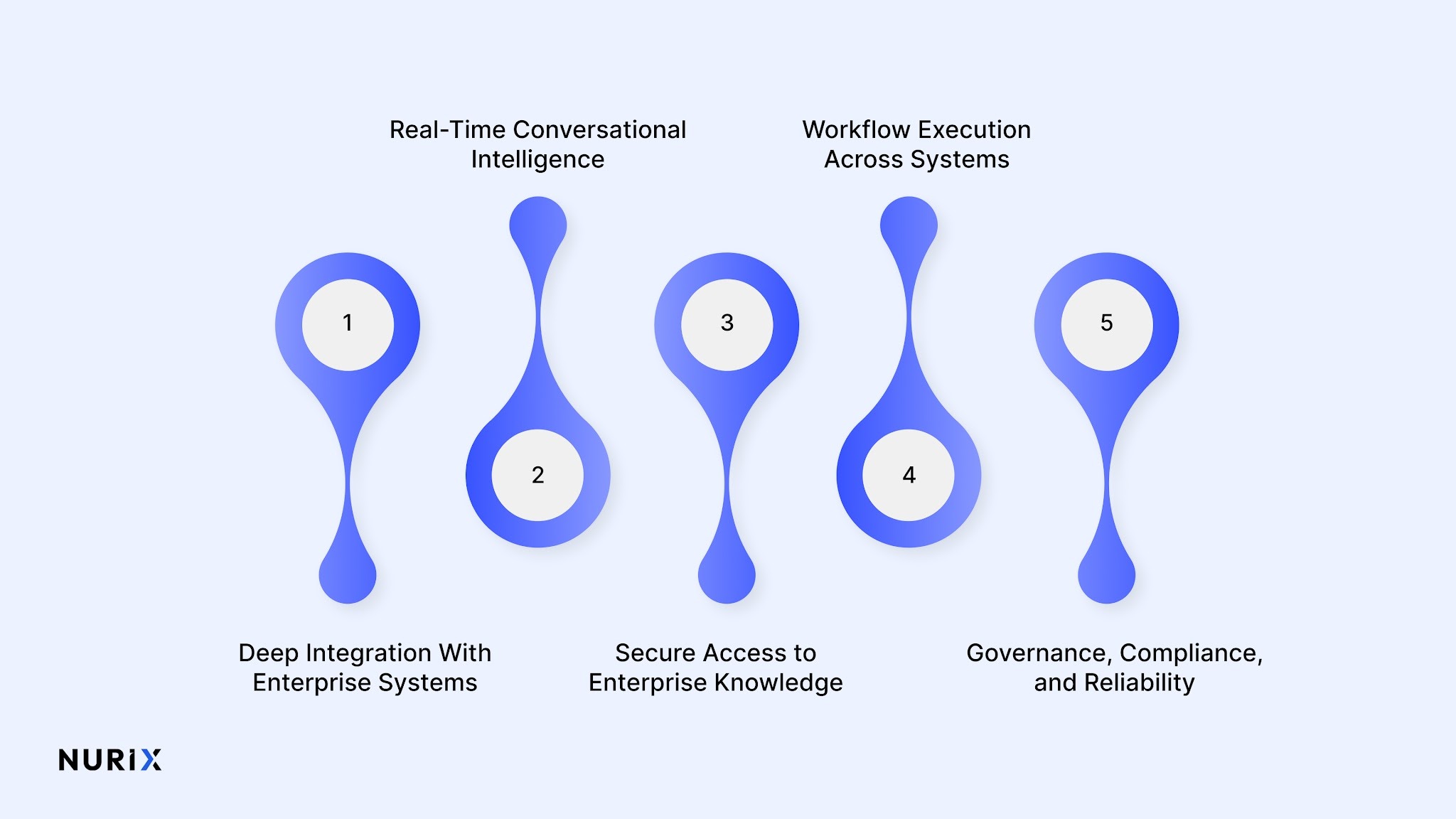
Consumer voice tools can answer questions, but enterprise environments need systems that can carry out operational tasks across business platforms. Voice AI must access enterprise data, automate workflows, and stay reliable at scale.
Below are the following capabilities that define production-ready enterprise voice AI systems.
1. Deep Integration With Enterprise Systems
Enterprise voice agents need to connect directly to systems like CRM, ERP, and support platforms. These integrations let the AI retrieve records, update data, and trigger workflows during conversations.
2. Real-Time Conversational Intelligence
Enterprise voice AI must process speech, understand intent, and generate responses in real time. This requires tightly integrated speech-to-text (STT), natural language processing (NLP), and language models that keep context throughout the conversation.
3. Secure Access to Enterprise Knowledge
Voice agents must pull accurate answers from internal documentation, knowledge bases, and operational data systems. Secure retrieval ensures responses are based on verified enterprise information, not generic AI outputs.
4. Workflow Execution Across Systems
Enterprise voice AI must perform actions such as creating support tickets, updating customer records, scheduling services, or routing requests. This turns voice interfaces from simple information tools into operational automation systems.
5. Governance, Compliance, and Reliability
Enterprise deployments need strict access controls, audit logs, and compliance safeguards for sensitive customer and operational data. Voice AI platforms must also stay reliable under high interaction volumes across support, sales, and operations.
Platforms such as NuPlay, an enterprise conversational AI and voice AI platform that deploys AI agents to automate sales, support, and operational workflows, are designed to meet these enterprise requirements.
Once the necessary capabilities are defined, it’s easier to see how voice AI can be applied across various enterprise operations.
5 Common Uses of Voice AI in Enterprise Operations
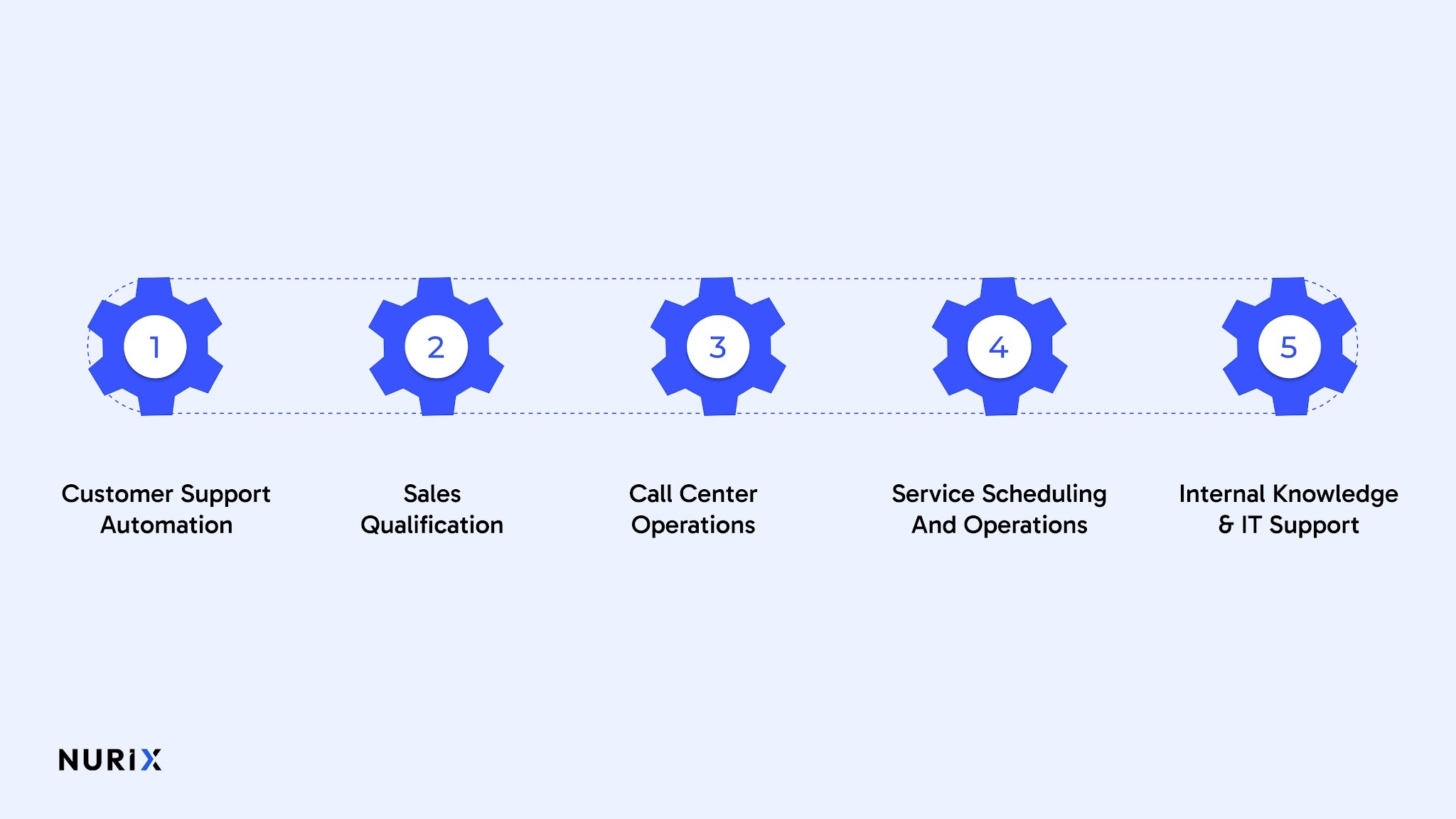
Voice AI is already being used in many enterprise environments where conversations drive customer interactions and operational workflows. Organizations use conversational and voice AI to automate high-volume interactions, speed up responses, and capture structured operational data from conversations.
The most common enterprise applications of voice AI include:
1. Customer Support Automation
Voice AI agents now handle high-volume support tasks, such as order tracking, account updates, subscription changes, and troubleshooting. These systems understand customer intent in real time and either resolve the issue or route it to the right human team with full context.
2. Sales Qualification and Lead Engagement
Voice AI agents handle inbound and outbound conversations to qualify leads before they reach sales reps. They capture buyer intent, answer product questions, and schedule meetings, all while automatically updating CRM systems.
3. Call Center Operations
Enterprises use voice AI to automate call routing, detect intent at the start of calls, and generate structured summaries after each interaction. The system captures key information such as customer issues, sentiment signals, and next steps, then automatically updates helpdesk or CRM records.
4. Service Scheduling and Operations
Voice AI systems handle operational conversations such as appointment scheduling, confirmations, and service requests. Industries such as healthcare, home services, and logistics use voice agents to coordinate bookings, send confirmations, and answer service-related questions.
5. Internal Knowledge and IT Support
Enterprises also use voice AI assistants to help employees access internal information and operational support. Workers can retrieve company policies, submit IT support requests, check system status, or access documentation through conversational queries.
Final Thoughts
OpenAI’s focus on audio highlights how voice is becoming a primary way to interact with AI systems. Instead of relying solely on dashboards and screens, organizations are increasingly using conversational AI and voice interfaces to access information and trigger workflows.
Enterprise platforms like NuPlay are bringing this shift into everyday business operations. Every month, NuPlay powers nearly 800,000 conversations, helping companies achieve 65% cost savings and 80% automation coverage. Across sales and service workflows, this translates to a 50% increase in efficiency.
Ready to explore enterprise voice automation? Schedule a demo to see how NuPlay deploys AI voice agents across customer support, sales, and operational workflows.
Author: Sakshi Batavia — Marketing Manager
Sakshi Batavia is a marketing manager focused on AI and automation. She writes about conversational AI, voice agents, and enterprise technologies that help businesses improve customer engagement and operational efficiency.